The idea
A chord symbol is not an instruction. It is a summary, and a summary that has thrown away the two things you actually need: which notes are available around it, and how it is arranged in space.
Chord-scale relationships restore the first. Voicings restore the second. This lesson does both, and it ends with the device that makes the second one cheap: instead of respelling six alterations to darken a chord, hold the root and move one triad. Greg's own framing of why that matters is worth taking literally. You could call a G triad over C a C major 9, "but that's very limited." Thinking in stacked triads is how "a lot of great musicians think of it, including Herbie Hancock."
There is an honest limit on the whole enterprise and you should know it before you start. Chord-scale thinking matches a scale to each chord one chord at a time, and Waters and Williams argue that this is precisely what misses the point in post-1960 harmony, because "if the objects, the chords, are largely standard and syntactic, their connections, the harmonic progressions, are what makes much post-1960s jazz composition tantalizingly resistant to analysis." Learn the chord-scale map as a set of options at the keyboard. Do not mistake it for an analysis.
Watch
"Jazz Lesson for Classical Pianists" first, because the prerequisites he states are yours exactly: know your scales and inversions, and you cannot improvise yet. He names four-note voicings as the target and says why, that they give "a beautiful sort of wide landscape" that is neither crowded nor thin while still showing the chord quality. "Drop-2 Voicings Explained," then its sequel "How to Comp using Drop-2 Voicings." These two are the spine of the middle of this lesson.
- [00:34] The name demystified. Start from a 3-5-7-9 comping shape and take the second voice from the top down an octave. In C minor that gives 7-3-5-9.
- [01:02] and [01:53] All four inversions, each with its second voice dropped, stacked up and down the keyboard. At [02:20] one of them produces an unwanted flat 9, and at [02:52] he shows the fix, which is moving the bottom note to the root.
- [02:52] The shortcut that halves the work: the C minor set is also the E flat major set, so one practiced landscape covers both.
- [03:34] Assignment 1, and it is the exercise below unchanged: run the whole up-and-down drop-2 cycle in minor through every key, chromatically.
- [04:42] Diatonic drop-2 movement. Alternate a diatonic drop-2 with a four-note diminished drop-2 on the next scale step. At [06:14] he names the resulting line the bebop scale, and at [07:54] he names the diminished chord a rootless V7 flat 9.
- In the sequel at [02:38], three colorings of the same D7 as interchangeable drop-2 options: 3-7-9-♯5, plain dominant 7, and flat 9. At [06:09], the instruction that outranks all of it: get one simple repeated comping rhythm solid across the whole form before you attempt anything complex. "Colors and Superimpositions on the Piano." Seventy minutes and the densest thing on the channel. Watch it twice.
- [00:26] and [03:39] The discovery and the naming. Holding an F triad while the bass moves to B flat sounds bright because the F triad supplies the 9, the 5 and the major 7 of B flat.
- [09:26] A warning worth more than the technique. Asked whether the G-over-C color relates to the G7-to-C tritone resolution, his answer is "no, it has nothing to do with it," and at [09:47] he explains that coincidences abound because the keyboard is "a combination of the physics of how our ear works and these accidents of history."
- [15:31] and [16:39] Why superimposition beats naming the chord, and who else thinks that way.
- [17:43] and [22:08] The brightness ladder, and why it closes on itself: "you're on C and then you're on F sharp eventually, as you get more dissonant in one direction or another."
- [18:43] and [19:04] How to keep it usable, by voicing the left hand 1-5-9 instead of adding the third, "so you have more space to do superimpositions that will not be too dissonant."
- [24:37], [25:52] and [26:16] The Petrushka chord, the diminished collection inside it, and the resolutions it opens.
- [01:00:59] and [01:07:34] The assignment, dictated on camera. It is exercise 5 below, unchanged. "Block Chords and Parallel Motion" at [00:50] for the definition, [02:46] for the diminished connector, [05:27] for doubling extensions in octaves, and [08:20] for the inner-voice melody, with the caveat at [10:18]: "there wasn't really any real counterpoint in there."
Jazz Harmony, Piano Chords - Drop-2 Voicings Explained
- the operation derived from scratch, all four inversions, and the all-keys assignment

How to Comp using Drop-2 Voicings
- the direct sequel, applying drop-2 through a whole form with three colorings of the same dominant
Colors and Superimpositions on the Piano
- 70 minutes building one system: a triad over a fixed root, moved around the circle, as the brightness control
Block Chords and Parallel Motion
- block chords defined and built on camera, plus the diminished connector and the inner-voice melody

Jazz Lesson for Classical Pianists
- the drop-2 derivation aimed at exactly your background, with the reason four-note voicings are the target

How to Become a Well Rounded Jazz Pianist (in 42 minutes)
- drop-2 derived from a voice-led sequence at 21:37, and the seventh chords derived from each parent scale
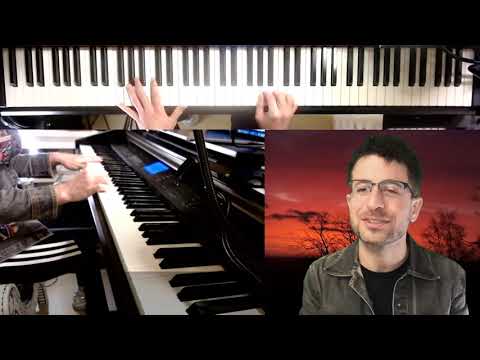
Jazz Scales to play over Maiden Voyage
- chord-scale choice treated as color choice, with the 3-5-7-9 shape planed chromatically over a held bass
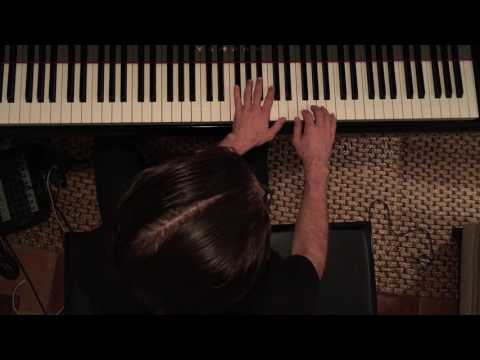
Actual Piano Practice Session: Drop 2 chords
- 58 unedited minutes of Greg drilling the exercise at 40 bpm, so you can see what the practice actually looks like
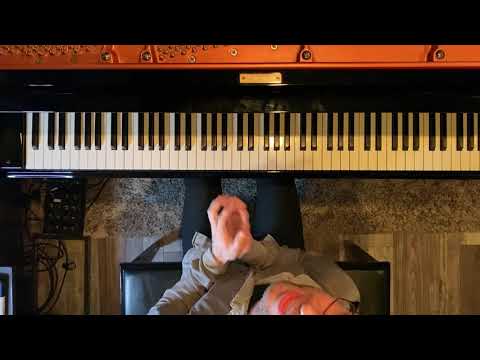
The Most Beautiful Chord in the World
- one altered voicing, learned from Ruslan Sirota, and the instruction that matters more than the notes
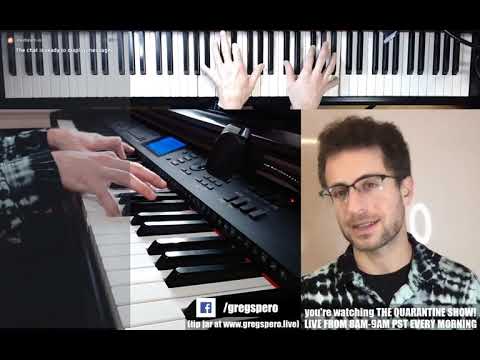
The most dissonant chord in the world
- every available alteration on one dominant at once, spelled out
At the piano
The chord-scale map
Every scale in this column you built in A9 or A10. Nothing new is being introduced. The map only tells you where each one goes.
| Chord | First-choice scale | Parent |
|---|---|---|
| maj7 | Ionian, or Lydian for the brighter reading | major |
| maj7(♯11) | Lydian | major |
| maj7♯5 | Lydian augmented | melodic minor |
| maj7(♭13) | Harmonic major | harmonic major |
| 7 | Mixolydian | major |
| 7(♯11) | Lydian dominant | melodic minor |
| 7alt (♭9 ♯9 ♯11 ♭13) | Altered | melodic minor |
| 7(♭9, ♮13) | Half-whole diminished | symmetric |
| 7(♭9, ♭13) | Phrygian dominant | harmonic minor |
| 7♯5 | Whole tone | symmetric |
| 7sus | Mixolydian, or the minor scale a fifth above the bass | major |
| m7 | Dorian, or Aeolian for the darker reading | major |
| m7(♭9) | Phrygian | major |
| m(maj7) | Melodic minor | melodic minor |
| m7♭5 | Locrian, or Locrian ♮2 for the ninth | major / melodic minor |
| dim7 | Whole-half diminished | symmetric |
Two entries are Greg's, not the textbook's. Over a sus chord he thinks a minor scale rooted a fifth above the bass, so A Dorian over D sus, spelling it out degree by degree at [01:18] to [01:29] of the Maiden Voyage video. And on m7♭5, at [15:03] to [15:37] of the jazz piano overview, he offers three readings at once: "you could do minor six, or you could do dominant seven based on the bass, or minor with the major six and seven is a good way to think of it too, because then you're outlining."
Drop-2
Drop-2 is one operation. Take a four-note voicing in close position, find the second voice from the top, move it down an octave. Greg derives it on camera in three separate videos with three slightly different close voicings, which confuses people. It is the same operation every time. What changes is which close voicing you started from.
There are four close inversions of any four-note chord, so there are four drop-2 shapes.
Cm7 close                       Cm7 drop-2 (bottom to top)

C  E♭ G  B♭   root position     G  C  E♭ B♭
E♭ G  B♭ C    1st inversion     B♭ E♭ G  C
G  B♭ C  E♭   2nd inversion     C  G  B♭ E♭
B♭ C  E♭ G    3rd inversion     E♭ B♭ C  G
The version Greg teaches most often drops the root and uses 3-5-7-9 as the close voicing, which turns a minor 7 into a minor 9 before you drop anything. His words: take C minor 7, "and maybe make it a C minor nine chord, so take away the one and just do three, five, seven, nine."
Cm9 close     E♭ G  B♭ D          (3 5 7 9)
Cm9 drop-2    B♭ E♭ G  D          (drop the B♭, the 2nd from the top)
                                  = 7 3 5 9
Two things fall out of that shape and both are worth having on day one. The C minor set is also the E flat major set, so every voicing you practice covers two chords. And one of the four inversions throws an unwanted flat 9 against the bass, which you fix by moving the bottom note to the root rather than by abandoning the inversion.
Now voice-lead it. Here is a ii-V-I in C with the top voice moving by step or not at all, which is the whole reason to use drop-2 rather than root-position stacks.
Dm7   drop-2 of D F A C     →   A  D  F  C
G7    drop-2 of D F G B     →   G  D  F  B
Cmaj7 drop-2 of C E G B     →   G  C  E  B

Voice motion:   A→G   D→D   F→F   C→B
                G→G   D→C   F→E   B→B
Two voices hold across each change and the other two move by step. That is the standard you are aiming for, and Greg's rule for it is to move only the notes that must move, to the nearest chord tone, with one exception, which he states at [38:37] of the Blue Bossa lesson: "in diminished seven chords you should use the root, because they're dissonant enough that you need something to ground it, even if the bass player is playing the root."
Block chords
A block chord is a melody note with chord tones packed underneath it, and the whole structure moves in parallel with the melody. Greg's definition, at [00:50]: look at the scale, take the melody note, and fill in underneath it with the basic chord tones.
Built from that rule in E flat, descending through the notes of an E flat major 9 stack:
melody F  (9)     G  B♭ D  F
melody D  (7)     F  G  B♭ D
melody B♭ (5)     D  F  G  B♭
melody G  (3)     B♭ D  F  G
melody F  (9)     G  B♭ D  F     (one octave lower)
Nothing moves except the whole block, and every voice takes the next chord tone down. That is parallel motion. Three things he adds on top of it:
- The one instead of the nine, for evenness. When the melody sits on the 9, putting the thumb on the root rather than the 9 evens the hand out. His words: "you could stay 9-3-5, but I went to the one with my thumb instead of the nine just to make it a little more even."
- The diminished connector. A diminished seventh chord is a stack of minor thirds that closes on itself after four of them, so the whole structure planes in minor thirds and lands anywhere you want. "It's all minor thirds, so you have your notes here enclosing your comping, and the comping is all just a minor third up, minor third up, minor third up, that leads very nicely to the one." Extend it a whole step and you are back into the major pentatonic, which is the alternation he attributes to Oscar Peterson.
- Doubling the extensions in octaves. An orchestration move, not a voice-leading one, and the fastest way to make a block-chord passage sound like a horn section rather than a piano exercise.
Colors and superimpositions
Hold the left hand still, voiced 1-5-9 so there is no third to fight with. Move one major triad in the right hand around the circle of fifths. Every step in one direction sharpens one more degree, every step in the other flats one more.
Left hand, fixed:   C  G  D    (1 5 9)

Brighter, up the circle          Darker, down the circle

G  triad   5  maj7  9           F  triad   11  13  1
D  triad   9  ♯11   13          B♭ triad   ♭7  9   11
A  triad   13 ♭9    3           E♭ triad   ♯9  5   ♭7
E  triad   3  ♯5    maj7        A♭ triad   ♭13 1   ♯9
B  triad   maj7 ♯9  ♯11         D♭ triad   ♭9  3   ♭13
F♯ triad   ♯11 ♭7   ♭9          G♭ triad   ♯11 ♭7  ♭9
The two columns end on the same chord, because F sharp and G flat are the same triad. That is Greg's point at [22:08]: "it's a relative term because you end up in the same place at the other side in complete dissonance." Bright and dark are directions, not destinations.
Three superimpositions he attributes to Herbie Hancock specifically, at [37:57] to [38:51] of the well-rounded-pianist video, worth learning as fixed shapes:
G minor triad over C     5  ♭7  9      makes C sus
A♭ major triad over C    ♭13 1  ♯9
G♭ major triad over F    ♭9  11  ♭13
G minor triad over F     9   11  13
His general rule for the whole family, at [38:17]: "it's always different types of major and minor chords that are superimposed."
Two chords worth stealing outright
The Petrushka chord is a C major triad and an F sharp major triad together. Greg's reading is that it is three stacked tritones, C against F sharp, E against A sharp, G against C sharp, and that all six notes sit inside the diminished collection, which is why it has "virtually every possibility of resolution built into the chord. Pick any one of those tritones and you can resolve it."
The most dissonant chord, as he spells it bottom to top on a C dominant: the 3 and the ♭7 first, then the ♯9, then the ♯5, then the ♭9, and the tritone on top.
E  B♭  D♯  G♯  D♭  F♯
3  ♭7  ♯9  ♯5  ♭9  ♯11
Every available alteration at once, which is why it is a maximum-tension approach to the tonic. His preferred resolution is into a minor chord with a major 7.
The most beautiful chord, learned from Ruslan Sirota, is the same family with a different color: ♯5, ♭9, ♯11, a doubled 5 and 7 in the middle of the voicing, and the ♯9 on top. Take the exact spacing off the video rather than from a page, because the spacing is the chord. His instruction about it, given at [01:13] and again at [02:08], applies to every voicing in this lesson: "make sure you hear and understand every bit of it."
Exercises
1. Four drop-2 shapes, four qualities
Do. For maj7, 7, m7 and m7♭5 on C, write out the four close inversions and their four drop-2 conversions. Play each set hands together. Then convert on sight: someone calls a four-note voicing, you play its drop-2.
Done when: you can convert any four-note voicing to drop-2 on sight, and all sixteen shapes on C are playable without reading.
2. The drop-2 cycle, twelve keys, chromatically
Do. Greg's Assignment 1, unchanged. Take the minor 3-5-7-9 shape, build all four inversions, drop the second voice in each, and run the resulting stack up and down the keyboard. Then move it chromatically: C minor, C sharp minor, D minor, all twelve. Metronome at 40. Then stage two, from his hour-long practice video: insert a four-note diminished drop-2 between every drop-2, ascending in minor thirds.
Done when: all twelve keys run up and down without reading, and you can state why the diminished passing chords repeat every minor third.
3. Drop-2 ii-V-I, twelve keys
Do. The three voicings printed above, transposed around the circle in both directions. Then comp them with one simple repeated rhythm across the whole form, which is what he demonstrates and what he tells you to get solid before anything complex.
Done when: all twelve keys run without stopping, with an average of one or two notes moving per change.
4. Block-chord descent
Do. Harmonize the descending E flat line above in parallel block chords. Then do it in three more keys. Then insert a diminished connector planing in minor thirds to lead back to the one, and extend it a whole step into the major pentatonic.
Done when: the whole structure moves in parallel with no gaps, and the connector works as a turnaround in four keys.
5. Inner-voice melody
Do. Over a I-vi-ii-V, play a simple melody on top with block chords beneath. Then play the same melody as an inner voice inside the comping, with the chord tones above and below it.
Done when: a listener can follow the melody in its inner position without being told it is there.
6. Greg's color assignment, exactly as dictated
Do. One key per day. Left hand 1-5-9, right hand major triads only. Up the circle: C, G, D, A, E, B, stop at F sharp. Then down: F, B flat, E flat, A flat, D flat, G flat. Improvise over each color before moving on. Then repeat the whole sequence keeping the same top note throughout, "because then it creates melody throughout what you're doing." Then repeat again restricted to one octave, from the 5 to the 5.
Done when: you can name the mood change at every step, the held top note produces an audible melody across all twelve colors, and the one-octave restriction produces phrases rather than scales.
7. The Petrushka chord, every way out
Do. Play C major and F sharp major together. Find all three tritones. Resolve each one outward and inward, which gives six destinations. Then pick any note of the chord as a root and resolve from there.
Done when: all six destinations are available without hesitation and you can name each one.
8. The altered voicing, all keys
Do. Build the six-note dissonant voicing above on C and resolve it to C minor with a major 7. Move it up a half step through all twelve keys. Fifteen minutes a day, alternated with drop-2 voicings on a standard, which is Greg's own stated practice allocation for this material.
Done when: the hand shape transfers cleanly to black-key roots and you can name every note's function without counting up from the root.
9. Planing the 3-5-7-9 shape
Do. Over a held D in the left hand, play the 3-5-7-9 of A minor in the right, then slide the whole shape down one half step, then back. The bass never moves. Greg calls the landing chord G minor at [03:04] of the Maiden Voyage video, but a half step below A minor's 3-5-7-9 spells A flat minor's, so move a whole step if you want the G minor he names.
Done when: you can plane the shape up or down a half step on demand over a held bass, in all twelve keys.
Checkpoint
- Any chord symbol from the map answered with its scale, spoken, in under two seconds.
- Sixteen drop-2 shapes on C, played from memory, and any called four-note voicing converted on sight.
- A drop-2 ii-V-I comped in all twelve keys with correct voice leading.
- A block-chord harmonization of a descending line in four keys, with a diminished connector inserted as a turnaround.
- The full color ladder run in one key, both directions, with the mood change named at each step.
- The Petrushka chord resolved six ways, one outward and one inward from each of its three tritones.
- The six-note altered voicing played in three keys with every note's function named.
Read
- Source course, Lesson 11 ("harmony as a living system") and Lesson 5 (consonance, dissonance, tension). Lesson 5 is the theoretical spine of the color ladder. Brightness and darkness are relative positions on a tension gradient, not properties of chords.
- Waters and Williams, Music Theory Online 16/3 (2010). Read the introduction and the "Vonetta" analysis. It is the strongest published objection to the chord-scale method you just learned, and it is specific: they show six consecutive chords moving between diatonic, hexatonic and acoustic collections and argue the moves matter more than the labels.
- Michaelsen, "Chord-Scale Networks in the Music and Improvisations of Wayne Shorter," Gamut 8/1 (2018). He criticizes both Waters and Williams and Tymoczko for glossing what he calls jazz harmony's "essential variability," and documents where the published lead sheets for "Witch Hunt" disagree with each other. Read it as evidence that the chord symbol was never the truth.
- Keith Waters, Journal of Music Theory 49/2 (2005): 333 to 357. On modes, scales and nonfunctional harmony in Hancock's compositions. This is the scholarly version of what Greg is doing by ear in the colors video.
- Debussy, "Clair de Lune," score. Greg's assignment, and his reason: it "actually uses everything that we've talked about in all these lessons: reverse harmony, tritone resolutions, colors." Annotate a page with the devices from this lesson.