The idea
Tempo is usually a setting. This lesson treats it as material, and there are two ways to do that.
Metric modulation keeps a small pulse constant and changes how many of it make a beat. Nothing speeds up; the unit of counting moves. Calder Hannan's analysis of Car Bomb's "Lights Out" is the cleanest modern case: the opening 42 seconds sound like a chain of tempo changes and are not. Each apparent tempo is an integer number of eighth notes between cymbal hits over an unchanging eighth-note pulse, and the whole passage is hearable as a dotted quarter at about 144 bpm.
Tempo canon runs two or more real tempi at once. Nancarrow's Study No. 36 is Canon 17/18/19/20, four voices in those tempo ratios. Ligeti spent a career getting that effect out of ten fingers.
One of these you can play. The other required a player piano, until Ligeti found a way around it.
Watch
Learn to play polyrhythms - 3rd lesson
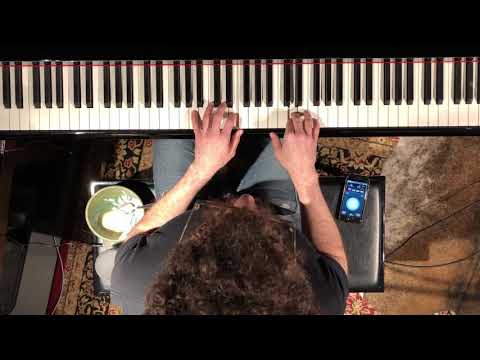
- [00:15] the metronome moves to one click every four beats. [00:36] do not look at it.
- [00:56] lock the left-hand bassline, then improvise in three. [01:24] switch the right hand to four over the same bassline. That switch is a tempo change that is not a tempo change, which is the subject of this lesson.
- [00:41] "eventually you'll be able to tell if you're slowing up or speeding down if you have a tendency to rush." You will need that diagnosis when your two tempi drift.

Good Time and Feel: Swing Demystified
- [03:33] onward, he views his own playing on a DAW MIDI grid at 120 bpm, first against a straight grid and then a triplet grid.
- [08:34] the finding that matters: his one is late and his "and" sits slightly ahead of the triplet, so "they almost even out to be straight in relation to each other, but pulled back behind the beat." A measured, consistent displacement, which is what a ratio is.
- [09:19] the practice loop: record, listen, then look. Every exercise below uses it.

For Musicians - Improve Your Time
- The internal-pulse meditation at a non-round tempo, dropping to 73 to make it harder. A tempo canon is unplayable without it.
Listen
Car Bomb, "Lights Out," 0:00 to 0:42.
Pass 1. Let it sound like accelerating tempo changes. That is the intended illusion.
Pass 2. Find the eighth-note pulse and hold it through the whole passage. It never changes.
Pass 5. Count the eighths between cymbal hits in each subsection. Hannan finds the interval shortens by one eighth per subsection. Write your counts and see whether they descend by one. Then tap a dotted quarter at 144 through all 42 seconds. If you can hold it, you have heard what the passage is.
Nancarrow, Study No. 36 (Canon 17/18/19/20). Four tempi at once; Gann calls the process easily audible and the climax thrilling. Listen for the voices separating and converging. Then Study No. 21 "Canon X," one voice accelerating while the other decelerates until they cross, and Study No. 40 "Transcendental" (Canon e/pi), Gann's record of Nancarrow's first irrational tempo relationship. Two tempi in the ratio e to π never align. Listen for the absence of a meeting point.
Ligeti, "Désordre." Right hand plays only heptatonic white notes, left hand only pentatonic black notes, producing what Steinitz calls a "combinatorial tonality," an illusory third tonality arising from the two. Listen for the accented group-heads that assemble into lines above the quaver continuum.
Ligeti, "Automne à Varsovie." Sixteen fast pulses per bar, notated in 4/4. At one point the right hand accents every fifth pulse and the left every third, and the ear fuses the chains into what Ligeti calls "a super-signal consisting of two melodies." Do not count.
The comparison
Parallel one: Car Bomb and Stravinsky's regrouped pulse. In L'Histoire du soldat and the Symphonies of Wind Instruments, a constant small pulse is regrouped into changing spans, so apparent tempo change is built from a fixed subdivision by varying the number of subdivisions per accent. Car Bomb does exactly that.
Where it breaks. Stravinsky renotates the meter to match the regrouping, so the barlines follow the ear. Car Bomb keeps the substrate constant and lets the listener's tactus be wrong. The wrongness is the aesthetic. This is the one place in the whole metal-classical comparison where Stravinsky is the right reference rather than the wrong one, and even here it is one-sided.
Parallel two: Nancarrow's tempo ratios and Babbitt's time-point system. Both project a pitch-domain construct onto the time domain by literal arithmetic. Nancarrow's Study No. 37 is a twelve-voice canon whose twelve tempos are proportional to the pitches of a chromatic scale, a time-point system in the most complete and most naive sense. Gann traces the source to Cowell's New Musical Resources (1930, pages 98 to 99), which proposed a scale of tempos whose half step is 15/14, a value Gann says appears nowhere else in the tuning literature. Study No. 37 uses exactly that set, which Gann calls "a dead giveaway."
Where it breaks. Babbitt's time points are modular positions inside a fixed metric span, engineered to preserve serial-array relations, per source course Lesson 19. Nancarrow's ratios are continuous and often irrational, and no modular system expresses those. There is nothing to complete and no aggregate.
Parallel three: Ligeti's tempo fugue and Bach's fugue. Ligeti named the device himself. One pulse-subject is stated at multiple simultaneous rates and the form is the accumulating divergence of the entries, a stretto whose interval of imitation is tempo rather than pitch and time.
Where it breaks. A Bach fugue's entries are discrete statements you can point at in the score. Ligeti's voices are never played. They are inherent patterns the ear assembles from accent chains, so there is no subject, no answer, no inversion, no episode. The comparison names the ambition, not the object.
The mechanism you can steal from "Désordre," stated exactly. Bars 1 to 3 sound together in eight quavers accented 3+5, 3+5, 5+3. From bar 4 Ligeti deletes one quaver from the right hand to make a 7/8 bar, and repeats that deletion every fourth bar, so the top line runs progressively ahead of the bottom. The right-hand melody is three phrases, initially 4 + 4 + 6 bars, iterated fourteen times, each restatement transposed up one step of the hyperphrygian mode. Steinitz hears the accented, octave-doubled group-heads as a structural line prolonged above the faster surface, which is a Schenkerian separation of foreground from middleground, except that the line ascends fourteen times and simply stops. No Ursatz, no closure.
Two more documented mechanisms. Ligeti stretched the 2:3 hemiola of Schumann and Chopin to 3:5, 5:7, even 3:4:5:7. And Arom's "rhythmic oddity", periods segmented near but not exactly at their midpoint under the rule half minus 1 against half plus 1, appears in Étude no. 8 "Fém" as 17 − 1 = 16 against 17 + 1 = 18.
The claim to be careful with. Ligeti's own limiting statement, quoted by Steinitz, is that only two of his works are deliberately based on contemporary mathematics: "Désordre," consciously based on the Koch snowflake, and the fourth movement of the Piano Concerto. Everything else is influence rather than system. The influence chain is documented from archives rather than interviews: Ligeti first encountered Nancarrow's music in 1980 and Arom's Central African recordings in 1982, met Arom in 1984 and Kubik in 1987, and wrote the foreword to Arom's book. His words there are the ones to keep: the patterns individual musicians play "are quite different from those which result from their combination. In fact, the ensemble's super pattern is in itself not played and exists only as an illusory outline."
And the goal, in Taylor's footnote. "For Ligeti, one important goal was to produce a rhythmic complexity comparable to Nancarrow's using only a single, living interpreter." That is the virtuosity thesis of this course in one sentence.
At the piano
Metric modulation, three steps. Set a click at 132 eighths per minute and play a low note on every eighth without stopping. Accent every 7 eighths for 4 cycles, then every 6, then 5, then 4, saying the number aloud before each change. Then drop the click and hold the eighths yourself. This is the Car Bomb passage reduced to one hand.
Dotted-quarter check. Through all of that, tap a dotted quarter with your foot. It stays at one tempo. Prove it with a recording and the DAW grid, following the loop from Swing Demystified.
Tempo canon, two hands, 3:4. Right hand plays a six-note figure at one note per three sixteenths, left hand the same figure at one per four. Start together. They separate and meet again after 12 sixteenths per figure note. Play until the meeting is predictable. Then 5:7, realignment at 35. This is hard and that is the point.
Ligeti's deletion procedure. Write eight quavers per bar accented 3+5. Play four bars. On bar 4, delete one quaver from the right hand only, making it 7/8. Repeat the deletion every fourth bar. After sixteen bars, notice how far ahead the right hand has run.
Accent chains, "Automne" reduction. Sixteen sixteenths per bar, both hands on a bland repeated figure, right accenting every fifth, left every third.
Exercises
1. The constant pulse
Do. Play the accent ladder 7, 6, 5, 4 over an unbroken eighth-note pulse at 132, with your foot on a dotted quarter throughout. Record it.
Done when: The DAW grid shows your eighth notes evenly spaced across all four subsections, with no tempo drift at the changes.
2. Count Car Bomb
Do. Count the eighths between cymbal hits in each subsection of "Lights Out," 0:00 to 0:42.
Done when: Your sequence descends by one per subsection and you can tap dotted quarter at 144 throughout.
3. 3:4 tempo canon
Do. One figure, two hands, one note per three sixteenths against one note per four. Start together, play to realignment, stop there.
Done when: You land the realignment three times running without counting out loud.
4. 5:7 tempo canon
Do. Same figure at five against seven, realignment at 35 sixteenths per figure note.
Done when: You state the realignment point before playing and land it once cleanly.
5. Ligeti's deletion
Do. Notate 16 bars of 8 quavers accented 3+5, delete one quaver from the right hand every fourth bar, play hands together at 40 bpm.
Done when: The deletions land on bars 4, 8, 12 and 16, and you hear the right hand run ahead.
6. Two accent chains
Do. Sixteen sixteenths per bar, right hand accenting every fifth and left every third, eight bars. Record and listen back.
Done when: On playback you hear two implied lines that neither hand is playing.
Compose
Write a two-part piece, four to five minutes, in two movements.
Movement one: metric modulation. One unchanging pulse throughout. Build at least four apparent tempo changes purely by changing the number of pulses per accent. Notate the constant unit as a metronome mark at the top, never change it, and write the equivalence at each modulation.
Movement two: tempo canon. Two voices at a stated ratio from Nancarrow's practice: 3:4, 4:5, 5:6, or 17:18 if you are brave. State the ratio at the top. The voices must meet exactly once.
The one technique that must be audible: in movement one a listener should be unable to find a tempo change with a metronome, and in movement two should hear two speeds at once.
Checkpoint
- Play the accent ladder with a provably constant pulse, verified on a DAW grid.
- State what "Lights Out" actually does in two sentences, including the dotted quarter at 144.
- Play a 3:4 tempo canon to realignment, three times running.
- Reproduce Ligeti's "Désordre" deletion procedure on paper from memory, and state his own limit on the mathematics claim, naming the two works.
- Say in one sentence why Nancarrow's e:π canon cannot be a Babbitt time-point system.
- Hand in the two-movement piece with the ratio stated on the score.
Read
- Gann, The Music of Conlon Nancarrow (1995). The chapter sequence is the taxonomy: ostinato studies, isorhythm, canon, acceleration studies, sound-mass canons. Sixty-five works, effectively the whole output.
- Gann's Annotated List of Works online. Use only the ratios given there: Study 36 = Canon 17/18/19/20; Study 40 = Canon e/pi; Study 49 = Three Canons, 4/5/6; Study 37, twelve tempos proportional to a chromatic scale; Study 48 = Canon 60/61; No. 21 "Canon X" and No. 22 = Canon 1%/1.5%/2.25% per note; No. 1 (4:7) and No. 5 (5 against 7) for ostinato.
- Gann's 2014 MTO keynote, free online, for the Cowell provenance and Study No. 41's cube roots.
- Steinitz 1996, free PDF, for the "Désordre" mechanism and Ligeti's own limit on the mathematics claim. Taylor 1997, free online, for tempo fugue and the footnote naming the Nancarrow goal.
- Scherzinger 2006, free author PDF, for the archival influence chain and Arom's rhythmic oddity. Use it for influence claims because it works from sketches, not interviews. Arom (1991) carries Ligeti's foreword at xvii to xviii and the rhythmic-oddity rule at page 246.
- Hannan, "Metric Complexity in Car Bomb's 'Lights Out'" on his blog Metal In Theory. Label it an analytical blog post by a credentialed metal theorist, not scholarship.