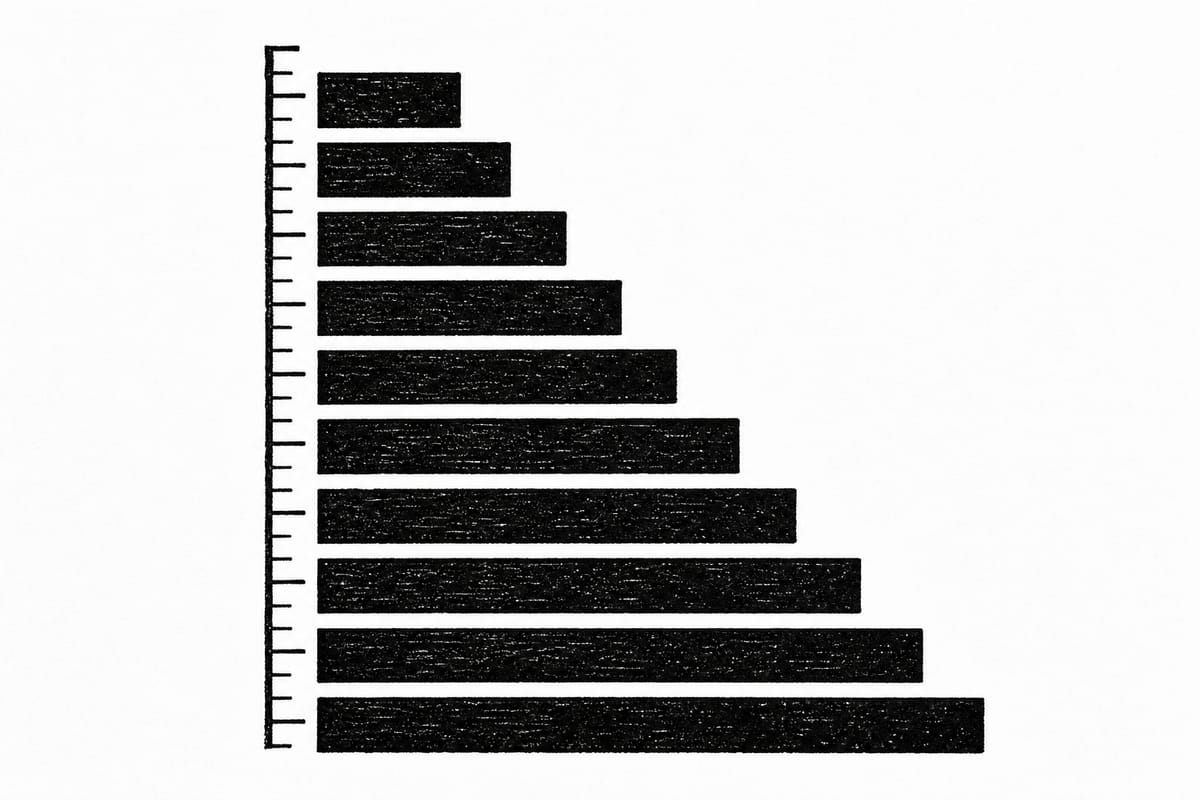
The idea
An odd bar can be arbitrary or the output of a rule. Only one of those is composition.
Gregory McCandless's term for the rule in Dream Theater's music is the ABAC Additive Metrical Process: a phrase-like unit built from four subphrases in the order a-b-a-c, where the metric cardinalities satisfy B greater than A, C greater than A, and C greater than B. So a non-isochronous quadruple hypermeasure such as 3+4+3+5. The head is static because it repeats exactly. The tail is variable because it grows. The title's allusion to Reich is deliberate: the metric irregularity is processual, not arbitrary. The odd bar is what happens when a growth rule is applied to a regular unit.
Steve Reich states the doctrine behind it: "I do not mean the process of composition, but rather pieces of music that are, literally, processes." Babbitt supplies the extreme version, mapping an ordered pitch row onto a modular attack grid.
Three composers, one question. What if the rhythm is not chosen note by note but generated?
Watch
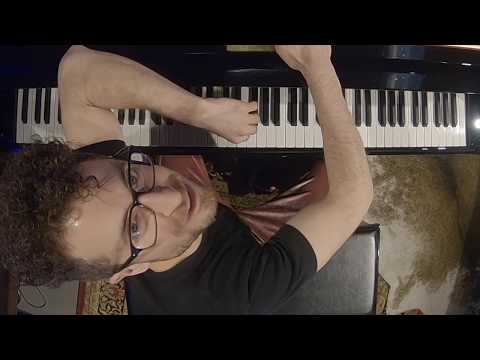
Tigran Hamasyan Transcription
- [15:48] is the moment the lesson turns on. Greg counts the phrase lengths and lands on 5, 5, 5, 6, 7, 6, 5. "He's elongating the phrasing and then shortening it."
- [18:22] to [18:41] he names the device: "creating patterns based on increasing number of notes in phrase, especially if it's over an ostinato." Additive process, discovered by counting rather than read from a book.
- [04:56] the left hand is an ostinato in 6/8 that is really 12/8; [01:50] the right hand superimposes groupings of five; [07:36] three fives plus three beats fills fifteen against twelve.
- [30:48] onward, the metronome climbs from 20 bpm. That is the tempo an additive phrase has to be learned at.
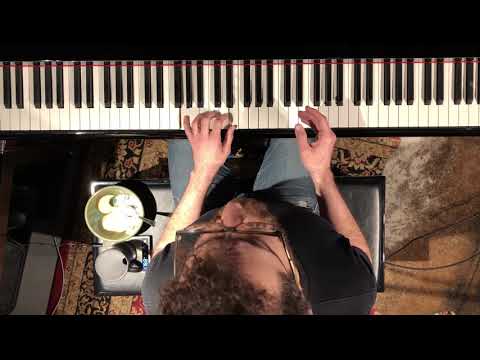
Polyrhythmic Exercise
- [00:04] "it's an exercise I actually do every morning." [04:57] the dosage: five minutes a day for a week.
- [01:52] to [02:11] the conversion: take a three count and make it a four count over the same left hand. [02:38] the triplets become sixteenths in a slightly longer bar. The unit grows; the material does not change.
- [02:56] "try to speak in phrases so that question-answer form." Additive process is not an excuse to stop being musical.
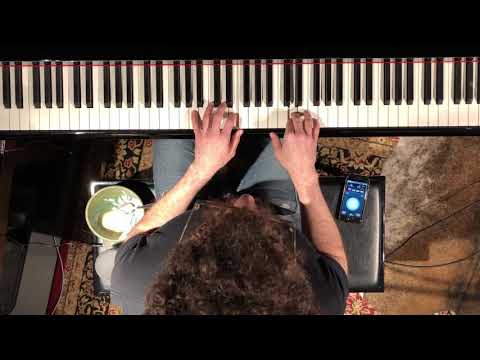
Learn to play polyrhythms - 3rd lesson
- [00:15] the metronome moves to one click every four beats. [00:36] "the challenge is to not look at the metronome." When a phrase grows by one beat per statement, the click cannot tell you where you are.
- [02:11] he catches himself rushing on camera. So will you.
Listen
"The Dance of Eternity," Dream Theater (1999), 6:13.
Pass 1. Listen once through without counting. Get the shape.
Pass 2. Listen for a four-part unit where parts one and three are identical and parts two and four are different lengths. Mark the timestamp of one you are sure about.
Pass 5. Count the beats of each of the four subphrases in your marked unit and write the four cardinalities. Check them against McCandless's condition: B greater than A, C greater than A and B.
What to tap. Tap only the first beat of each subphrase. Your taps will be unevenly spaced. That unevenness is the piece.
On the meter-change count. Jordan Rudess's video breakdown and press coverage say "over 128" meter changes; a Pianote article counts 127. Those are still journalism, and no scholar has published a total. What you now have instead is better than a total. McCandless's article carries an appendix, "Catalog of Metrical Complexities in Dream Theater's Music," which classifies the complexities album by album, song by song, with timestamps. Open it beside the recording. A catalogue that tells you what kind of complexity is happening and where beats a number that tells you only how many.
"Sacrificed Sons" (Octavarium, 2005), the instrumental interlude from 4:13. This is McCandless's worked analysis, so you can check your ear against a published one. Myung's distorted bass alludes twice to the two-bar Riff A, then the full band repeats it four more times. Four bars in, the drums reverse their accents from odd beats to even ones, which puts an ordinary backbeat under an extraordinary meter. Listen for that flip. At the transition Riff A overruns its four-bar hypermetric unit and is truncated and mutated until it stops resembling itself, clearing the way for Riff B. McCandless calls that combination of motivic fragmentation, metric contraction and transitional function metrical liquidation, and it is the single most useful term in the article for a composer. Riff B is then stated eight times, altered on every other statement, where one F sharp passing tone turns a mixed 4/4-plus-7/8 pattern into two plain bars of 4/4. From 5:19 the ABAC pattern runs on the one-, two- and four-bar levels at once, aiming at the return of Riff A at 5:45.
"Constant Motion" (Systematic Chaos, 2007), 0:01 to 0:40. Sixteen bars heard as four non-isochronous quadruple hypermeasures, on E throughout, splitting into eight bars of E Locrian and eight of B Locrian over an E pedal. The first bar is the seed for everything after it: a triple unit of 2+2+3, which is 7/8, expanded by repeating its last term into 2+2+3+3, which is 10/8. One bar generates the whole introduction. Count the first bar until you are certain, then listen for that shape at every larger level.
Piano Phase, part one. Two pianos, a twelve-note pattern using only five pitches, E, F♯, B, C♯, D, across 32 measures in three sections. Both players lock in unison; one holds tempo while the other accelerates until one note ahead; they lock again; repeat. In part one that cycle runs twelve times, returning to unison. Count the twelve. Reich's point is that you should be able to hear the process the entire time.
Radio Rewrite, movements 1 and 2. Five movements, fast-slow-fast-slow-fast. Reich's own account: the fast movements draw on Radiohead's "Jigsaw Falling Into Place," the second and fourth on "Everything In Its Right Place," "slower, more mysterious." He is emphatic it is not a rock piece: "if you didn't know the original material, rock and roll wouldn't cross your mind."
"Ohmnivalent," Anomalous, final module. Hannan's analysis: locally a-b-a-c-a-b-a-d, which parses at the larger level as ab-ac-ab-ad. Nested ABAC. Hear the nesting.
The comparison
Parallel one: ABAC and the Classical expanded consequent. A symmetrical antecedent-consequent pair is deformed by lengthening only the second half, and the deformation is heard against the symmetrical model that generated it. Source course Lesson 12 is Haydn and the art of surprise; the "one more time" technique and the expanded consequent live there. Hannan 2022 goes further and subsumes McCandless's construct: "the ABAC Additive Metrical Process is actually a common subset of the ubiquitous ABAC phrase schema," in which "the music rotates through static and variable parts, the beginning (a) is static because it is repeated exactly, while the ending is variable (b or c) because it changes."
Where it breaks, in one sentence. Haydn expands harmonic time and progressive metal expands metric cardinality. In Haydn the extra bars prolong a dominant or evade a cadence, so the phrase's length is a consequence of the harmonic rhythm and the listener waits. In ABAC-AMP beats are added to a metric container with no harmonic obligation, so the listener counts.
Parallel two: Reich's process and any generative rhythm. Reich's prohibitions are the useful part. No "hidden structural devices." "Once the process is set up and loaded, it runs by itself." "One can't improvise in a musical process, the concepts are mutually exclusive." And the payoff he cares about is the "impersonal, unattended, psycho-acoustic by-products": sub-melodies heard inside repeated patterns, difference tones, stereophonic effects, slight irregularities in performance.
Where it breaks. McCandless's additive process is a technique the band applies and abandons at will, not a process that runs by itself, and it is played by improvising musicians inside a song. Reich would not call it a process at all; he excludes modal musics on the same grounds, as "strict frameworks for improvisation. They are not processes." And Scott Schumann documents composers in Hamasyan's music routinely cutting a cycle short so a four-bar hypermeasure survives, an incomplete cycle. That intervention is exactly what "Music as a Gradual Process" forbids.
McCandless draws the line himself, twice, and both times are worth copying. On the music: minimalist process is called static, non-teleological, vertical time, while Dream Theater's additive structures are unambiguously metrical, because the drum grooves supply orienting accents and the expanding units are large enough to be heard as bars. So the band borrows minimalism's surface and inverts its temporality. On the influence claim: he says the Reich connection is esthesic rather than poietic, a listener's association and "a connection for which I have found no historical corroboration." That is the sentence to imitate every time you want to say one musician got something from another and cannot prove it.
One number for scale. Citing Biamonte 2011, McCandless reports large-scale metric dissonance at about 69% in Tool, 29% in Led Zeppelin, and 7% across two hundred of Rolling Stone's "Greatest Songs of All Time." Whatever you are writing, that is the field you are writing into.
Parallel three: Babbitt's time-point system. Source course Lesson 19 gives the mechanism precisely: "Divide the measure into twelve equal time points, twelve sixteenth notes in a measure of 12/16. Assign to each pitch class a corresponding time point: pitch class 0 (C) corresponds to time point 0 (the downbeat). If the row proceeds from pitch class 3 to pitch class 7 (an interval of 4 semitones), the corresponding attack points are separated by 4 time units." Published 1962. The course also gives the distinction that makes it usable: Messiaen serialized durations, Babbitt serialized attack points, and duration serialization tends to produce uniform undifferentiated textures while attack-point serialization "preserves the possibility of rhythmic grouping, accent, and meter."
Where it breaks. Babbitt's time points are derived from a pitch-class row and systematically ordered, with an aggregate to complete. Metal's cycles are locally invented riff lengths with no generative row behind them and nothing to complete. Capuzzo's framing of Meshuggah's micro-level deviance rests on the same premise, that the attack-point grid rather than the pitch content is the object of composition, but the resemblance ends at the premise.
The honest summary. Three growth rules, three sources of authority: Haydn's is harmonic, Reich's mechanical, Babbitt's serial. Metal's is none of the three. It is a rule the band decided to follow for eight bars.
At the piano
Build an ABAC unit. Left hand, a single low note marking the first beat of each subphrase. Right hand, a two-bar motive.
- a = 3 beats. Play the motive's head.
- b = 4 beats. Play the head plus one beat of tail.
- a = 3 beats. Identical to the first a. Exactly identical.
- c = 5 beats. Play the head plus three beats of tail.
Total: 15 beats. Loop it eight times at 66 bpm with a click on every beat. Then move the click to the first beat of the unit only, so you are counting fifteen internally.
Then grow it linearly. McCandless distinguishes a linear additive process, where each successive unit grows, from an interrupted one, where growth is broken by a return. Play 3-4-3-5, then 3-5-3-6, then 3-6-3-7. The a is frozen. Everything else moves.
Then interrupt it. Play 3-4-3-5, 3-5-3-6, then return to 3-4-3-5. Hear how much stronger the return is than any of the growths.
Phase, two hands. Play the Piano Phase pattern with both hands in unison at a slow tempo: a twelve-note pattern on E, F♯, B, C♯, D. Now hold the left hand steady and move the right hand one sixteenth ahead. Lock. Then one more. Twelve moves brings you home. This is genuinely difficult and worth a week.
Time points, at the keyboard. Take a row's first six pitch classes. In a bar of 12/16, place attacks at the time points those pitch classes name. Play the rhythm on one note, then with the actual pitches. Do it for two hexachords: the all-combinatorial C hexachord {0,2,4,5,7,9} spreads its attacks evenly, while the chromatic A hexachord {0,1,2,3,4,5} clumps all six into the first half of the bar.
Exercises
1. Count Tigran
Do. Take a recorded line you love over a repeating ostinato. Notate its phrase lengths as a bare sequence of numbers, the way Greg gets to 5-5-5-6-7-6-5.
Done when: You can write the sequence from memory, and state which numbers are growth and which are contraction.
2. The frozen head
Do. Write and play a 3-4-3-5 ABAC unit at 66 bpm, then 3-5-3-6, then 3-6-3-7.
Done when: A listener confirms the a subphrase is literally identical in all three units, and you can play the three back to back without stopping.
3. Linear against interrupted
Do. Record two 90-second takes over one ostinato. Take one grows every unit; take two grows twice, then returns.
Done when: You can say which take has a shape and defend it.
4. Twelve phases
Do. Play the Piano Phase pattern in unison with both hands, then shift the right hand one note ahead and lock. Repeat until you return to unison.
Done when: You complete all twelve shifts in one sitting, with each lock stable for at least eight repetitions before the next shift.
5. A time-point rhythm
Do. Map two hexachords onto a 12/16 bar as attack points by the Lesson 19 procedure. Notate both, play both on one pitch.
Done when: The two rhythms differ audibly in density and placement, and you can explain the difference from the hexachords' intervallic content.
6. Break Reich's rule on purpose
Do. Set up a process that would run to a computable return, then cut it one step short so the phrase fits a four-bar hypermeasure, as Schumann documents in Hamasyan.
Done when: You can play the complete and incomplete versions and state what each buys you.
Compose
Write a two-minute instrumental piece in which every metric irregularity is the output of a stated rule.
- Write the rule down first, in one sentence, at the top of the score. It must be a growth rule.
- The head of your unit is frozen and never changes length across the whole piece.
- Somewhere in the second half, break the process once, deliberately, and make that break the climax.
- Any instrumentation. Piano alone is acceptable.
The one technique that must be audible: a listener who is told the rule should be able to hear it running.
Checkpoint
- Play a 3-4-3-5 unit at tempo with the click on the unit's first beat only.
- Demonstrate linear and interrupted additive processes over the same ostinato.
- Complete twelve phase shifts of the Piano Phase pattern.
- Recite Babbitt's time-point mapping in one sentence and produce a time-point rhythm from a hexachord on paper.
- State in one sentence the difference between what Haydn expands and what Dream Theater expands.
- Hand in the two-minute piece with its rule written at the top of the score.
Read
- McCandless 2013, Music Theory Online 19, no. 2, https://mtosmt.org/issues/mto.13.19.2/mto.13.19.2.mccandless.html, free and citable. The title word is "Structures," not "Techniques"; the wrong version circulates widely. Use this rather than the 2010 dissertation. Read it for the ABAC-AMP definition, the cardinality conditions, the linear-versus-interrupted distinction, metrical liquidation, and the "Sacrificed Sons" and "Constant Motion" analyses.
- McCandless's appendix, "Catalog of Metrical Complexities in Dream Theater's Music," https://mtosmt.org/issues/mto.13.19.2/mccandless_appendix.pdf. Every album, song and timestamp, classified. This is the most usable single document in the whole reading list, because you can put it next to a recording and work. Start with "The Ytse Jam" (When Dream and Day Unite, 1989), which has the clearest linear additive process in the catalogue and a polymetric passage at 1:24 to 1:46 running 4+3+2+3 over 3/4.
- Hannan 2022, free online, for structural density and clarity, for the argument that ABAC-AMP is a subset of the general ABAC phrase schema, and for the nested analysis of "Ohmnivalent."
- Reich, "Music as a Gradual Process" (1968), three pages, at 34 to 36 of Writings on Music. Read it twice. The prohibitions matter more than the affirmations.
- Saltini, Intégral 7, for beat-class sets in mod-12 space: Clapping Music as {0,1,2,4,5,7,9,10}, vector ⟨456562⟩. Forte's apparatus moved into the time domain.
- Schumann 2021, free online, for complete and incomplete cycles and the phrasal, structural and developmental functions a cycle can serve.
- Source course, Lesson 19, for the time-point system, attack points versus durations, and the six all-combinatorial hexachords. That lesson's hexachord labels are internally inconsistent; use the classification list, A = {0,1,2,3,4,5} and E = {0,1,4,5,8,9}.