The idea
Everything in Module 3 so far has made voices independent by pitch and rhythm together. This lesson removes pitch from the problem.
Two voices can be fully independent while playing one note each. A riff cycling every seven sixteenths and a kit holding 4/4 are two lines in counterpoint, and every principle from Lesson 6 applies: their profiles differ, they attract attention separately, and the interest lies in their relationship changing over time.
The number governing the whole texture is the one nobody in the band calculates. A seven-sixteenth cycle against a sixteen-sixteenth bar realigns after 112 sixteenths, which is seven bars. A five-sixteenth cycle realigns after five bars, a seventeen after seventeen. Once you know the number you know how long the passage wants to be, and whether you will let it reach its landing or cut it off first.
Watch
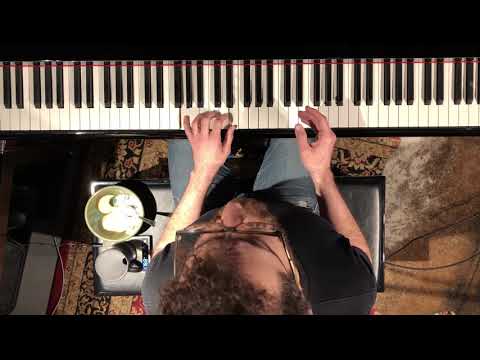
Polyrhythmic Exercise (https://www.youtube.com/watch?v=jmQjQ9DglIw)
- Greg's daily exercise: a Chick Corea bassline in the left hand, click on every beat at 90 [00:04], [00:29].
- The mechanism: convert the three count to a four count over the same left hand [01:52]–[02:11]. "The right hand is taking those triplets and moving it so the triplets are actually sixteenth notes in a slightly longer bar" [02:38].
- What makes it music: "try to speak in phrases so that question-answer form" [02:56]. No scales inside the polyrhythm.
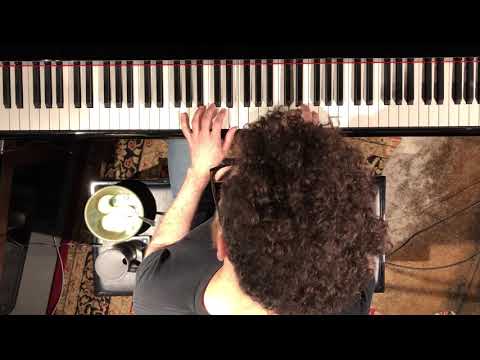
- Stop and regroup the moment you are off the beat [03:58]. Five minutes a day for a week [04:57]. Play Polyrhythms on Piano (https://www.youtube.com/watch?v=Z_YBKJMHSu0)
- Remove beat one from the click [01:07]. "It forces you to have your internal clock synced up with the metronome" [01:24].
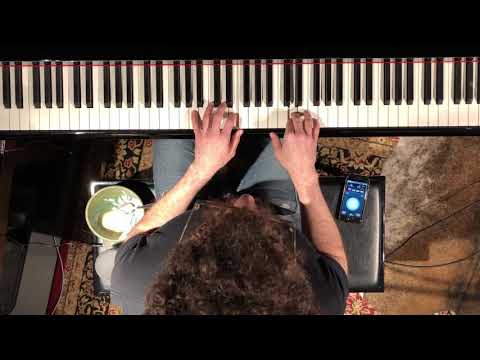
- "It's all about phrasing, it's really just a phrasing difference" [00:57]. The note values do not change, the grouping does. That sentence is the whole of metric superimposition. Learn to play polyrhythms, 3rd lesson (https://www.youtube.com/watch?v=n3OH1QMq0g4)
- One click every four beats [00:15], and do not look at the metronome [00:36].
- Order: lock the left hand, improvise in three with the right, then switch the right to four [00:56], [01:24]. For Musicians, Improve Your Time (https://www.youtube.com/watch?v=AokHwmd27Eg)
- Sit up, eyes closed, click at an odd tempo such as 104 so you never calibrate to a round number.
- Turn off everything but the downbeat and clasp your fingers on beat one while feeling every quarter internally. He did this for an hour and a half in a day, and it is what makes every other exercise here possible. Polyrhythmic 17/16 groove (https://www.youtube.com/watch?v=IQeE6QTQjmE)
- No talking, just the groove. Count the cycle and find where it comes back around, seventeen bars if you count in 4/4.
Polyrhythmic Exercise
- the origin exercise of Greg's daily routine: a fixed left-hand bassline with the right hand regrouping three into four
Play Polyrhythms on Piano
- the same exercise with the downbeat click removed, which is the real test of an internal grid
Learn to play polyrhythms - 3rd lesson
- one click every four beats, and the rule that you do not look at the metronome

For Musicians - Improve Your Time
- the seated time-internalisation practice that makes the rest of this lesson possible
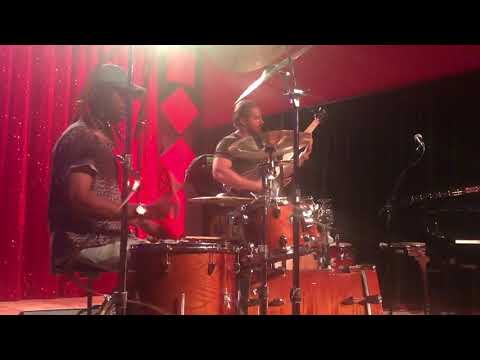
Polyrhythmic 17/16 groove
- a performance, no talking: hear a 17-sixteenth cycle slide against a felt four
Listen
Meshuggah, "Bleed." Lucas's timestamped account is your listening script. The cymbals state 4/4 clearly until about 1:25, when the drums move to eighths with a popping kick. At about 1:40 the cymbals join that pattern, leaving the vocals alone carrying the 4/4. From about 1:58 the lead guitar marks the downbeats.
Pass one: tap quarter notes for the whole passage and do not stop. Pass two: follow the guitar cycle only and try to count its length. Pass five: notice that the thing carrying the 4/4 changes hands three times while the 4/4 itself never changes. That is the point.
Meshuggah, "Lethargica." Lucas's example of a rotated riff, a loop whose durational pattern makes it sound as though it starts in the middle. Listen for your own uncertainty about where it begins. That uncertainty is composed.
Meshuggah, "Rational Gaze." Pieslak's example. The riff's attack points do not divide the bar evenly, so the pattern re-phases while the backbeat stays fixed. Sing its rhythm, not its pitches, saying "da" on every attack. If you cannot, you cannot yet write one.
The comparison
The exact parallel. The source course already contains the bridge, and it is not a metaphor. In Lesson 6 it proposes species counterpoint for drummers: four-limb independence practised as four-voice rhythmic counterpoint, governed by rhythmic differentiation between limbs, contrary motion where one limb thickens as another simplifies, and structural awareness. Lesson 10 generalises it: "differentiate the voices in as many dimensions as possible, rhythm, register, dynamic, timbre, articulation."
A Meshuggah riff over Tomas Haake's kit is that idea with two voices instead of four. Guitars, bass and kick state a cycle of odd cardinality while the cymbal hand and snare backbeat hold an unbroken 4/4. Pieslak's term is metric superimposition, and his method is attack-point interval analysis after Yeston plus Lester's textural accent. His structural finding is the one that matters to a composer: the superimposed layer is not free. A symmetrical hypermeter bounds the odd riff, so the irregularity is always a foreground event over a regular background.
Lucas adds the formal consequence. The band builds songs in segments of eight, sixteen or thirty-two bars of 4/4, and the looping riffs "fall in and out of alignment with this background structure, but rarely overcome it," because the cycle is cut off wherever it stands when the segment ends. That truncation generates the form. Nothing resolves. Something stops.
Where it breaks, and it breaks against Stravinsky. The comparison you will read everywhere is Meshuggah and Stravinsky, and it is wrong. Stravinsky renotates the meter bar by bar: 5/8, then 7/8, then 3/16. The bar itself is the composed object. In Meshuggah the bar is a fixed container and only its contents move. Haake has said repeatedly that everything is built on a 4/4 platform, that he plays eighths on the hi-hat so the audience can headbang, and that riffs of thirteen or seventeen notes simply roll over the barline.
The consequence for a listener is decisive. In Stravinsky the tactus is genuinely displaced and there is nothing left to count against. In Meshuggah you can always count 4/4, which is why Lucas can describe an audience counting in the balcony and moshing in the pit to the same music. The right classical comparisons are Krebs's grouping dissonance, Reich's phase process, and Babbitt's modular time points, all of which keep a fixed grid and vary a pattern against it. Stravinsky varies the grid.
Where the Krebs analogy itself breaks: his dissonances usually resolve, layers aligned at a cadence with harmonic syntax carrying the form. Meshuggah has no harmonic syntax to resolve into, so the alignment point is arithmetic and the resolution is the least common multiple arriving.
The instrument that declares the grid. Garza's contribution is to name the function. In post-millennial metal the time feel is set by the kick-snare alternation rate, and the timekeeping cymbal exists to declare the tactus and cue entrainment even when everything else is syncopated. He sorts cymbals by rhythmic frequency: once per beat, beat divisions, every other beat, beat subdivision. That is the continuo's job in a Baroque texture. Where it breaks: the continuo declares tactus and harmony at once, inseparably, while the cymbal declares tactus alone, which is why Garza can vary it independently of everything else, and why you can too.
One honest gap. Capuzzo's "Rhythmic Deviance in the Music of Meshuggah" follows Pieslak and is worth getting from a library. Its abstract promises analytic vignettes from six songs. Which six, and Capuzzo's taxonomy of deviance categories, sit behind a paywall and are to verify. Do not repeat a list of "Capuzzo's categories" from a secondary summary.
At the piano
The grid comes first. Ten minutes of the seated time practice at a non-round tempo before you touch the keys. Then set the click to beat one only.
Species over a polymetric ostinato. Left hand loops a seven-sixteenth cycle in 4/4 at 60 bpm. Right hand plays first species against it: one note per quarter, consonant with whatever the left hand sounds on that quarter.
LH cycle (7 sixteenths, looping):  E2 . E2 . B2 . E2   (attacks on sixteenths 1, 3, 5, 7)
RH: one note per quarter note, first species
Because the left-hand cycle is seven and the bar is sixteen, the same right-hand quarter meets a different left-hand attack every bar. Write out seven bars, which is one full realignment, and hand-check the interval on every quarter. This is the exercise the whole lesson exists for.
The Corea drill, as written. Bassline at 90 with the click on every beat, right hand improvising in phrases, then converting three into four over the unchanged left hand. Then thin the click to one per bar, then silence beat one.
Hands independent, not hands together. The left hand holds a cycle while the right does something with a different period. Practise the left alone until it survives you counting out loud in four over it.
Exercises
1. Cycle arithmetic
Do. For cycles of 5, 7, 9, 11, 13 and 17 sixteenths against a 4/4 bar, write how many sixteenths and how many bars pass before the cycle lands on a downbeat again.
Done when: you can produce all six numbers from memory and explain in one sentence why 8 and 4 do not belong on the list.
2. Rhythm-only transcription
Do. Transcribe the rhythm alone of the main "Rational Gaze" riff on a single line, no pitches, and count its cycle in sixteenths. Then do the same for the cymbal pattern under it.
Done when: you have two cycle lengths, you can clap each against the other for eight bars, and your predicted realignment matches the recording.
3. First species over a seven-sixteenth ostinato
Do. Build the ostinato above. Write a right-hand line of one note per quarter, consonant on every quarter, across a full realignment of seven bars. Prefer contrary motion.
Done when: you can play both hands at 60 bpm through all seven bars with the click on beat one only, and you can name the interval on any quarter you are asked about.
4. Second and fourth species over the same ostinato
Do. Rewrite Exercise 3 with two right-hand notes per quarter, dissonances only off the beat, approached and left by step. Then again with the right hand entering on the second half of each beat, tying over and resolving down by step.
Done when: both versions are playable at 60 and you can point to every dissonance and its resolution.
5. The rotated riff
Do. Write a nine-sixteenth riff and four rotations of it, each starting from a different point in the cycle. Loop each for eight bars and record all five.
Done when: you can identify by ear which rotation sounds as though it begins in the middle, and name the durational feature that caused it.
6. Change what carries the four
Do. Write thirty-two bars in which the riff cycle never changes while the instrument declaring the 4/4 changes three times, following "Bleed": cymbals, then a vocal or lead line, then a rhythm part marking downbeats.
Done when: a listener can still count four through all thirty-two bars, and you can name the exact bar of each handover.
7. The truncation test
Do. Take a seven-sixteenth riff. Version A runs its full seven bars to realignment. Version B is cut off at the end of bar four, starting the next section.
Done when: you can say which has a form and which has a period, and defend the choice you would make in a real piece.
Compose
Write two minutes for guitar, bass and drums in which the drums never leave 4/4 and the riff never sits inside it.
Constraints: one riff cycle of odd cardinality, stated in guitar, bass and kick together. A timekeeping cymbal that declares the tactus throughout, and that changes its rhythmic frequency exactly once. Formal segments of eight, sixteen or thirty-two bars, with the riff cut off at the segment boundary wherever it happens to be. One moment where the cycle lands on a downbeat, placed deliberately.
Then write the piano reduction and play it, one hand per voice, at whatever tempo you can hold with the click on beat one only.
Checkpoint
- State the realignment length in bars for cycles of 5, 7, 9, 11, 13 and 17 sixteenths against 4/4.
- Play first species over the seven-sixteenth ostinato through a full realignment at 60 bpm, click on beat one only.
- Clap the "Rational Gaze" riff rhythm against a steady four for eight bars without drifting.
- Hand over the two-minute piece with a score and a recording, and name the bar where the cycle lands.
- State why Meshuggah is not Stravinsky, in four sentences, using the background-pulse argument and the drummer's function.
- Say what Garza's timekeeping cymbal does, and what the Baroque continuo does that the cymbal does not.
Read
- Source course, Lessons 6 and 10 (/library/garnett-course.pdf). The species-counterpoint-for-drummers section, and the three ensemble principles: register separation, rhythmic differentiation, contrary motion.
- Pieslak 2007, Music Theory Spectrum 29/2, https://doi.org/10.1525/mts.2007.29.2.219. The founding article on metric superimposition. His analysis of "I" runs to pages 223–242.
- Lucas 2018, Music Theory Online 24/3, https://mtosmt.org/issues/mto.18.24.3/mto.18.24.3.lucas.html. Free and complete. Read it for the rotated riff, the segment lengths, and the "Bleed" timestamps. Her alternation of spectrograms with conventional transcription is worth copying.
- Garza 2021, Music Theory Online 27/1, https://mtosmt.org/issues/mto.21.27.1/mto.21.27.1.garza.html. Free and complete. The six riff types and four timekeeping-cymbal categories are directly usable as compositional choices.
- Capuzzo 2018, MTS 40/1, https://doi.org/10.1093/mts/mty005, plus the corrigendum at 40/1: 177, https://doi.org/10.1093/mts/mty012, for Example 12. Get it from a library before citing its categories.