The idea
Stravinsky took the twelve-tone system and made it produce his own sound. The source course puts it as bluntly as it can be put: "He did not submit to the twelve-tone system. He colonized it" (Lesson 21). The device that did the work is the rotational array, and it is a procedure you can run in twenty minutes with a pencil.
Take six notes in order. Rotate them, moving the first to the end, six times. Then transpose every rotation so it starts on the original first pitch. You now have a 6x6 grid where every row starts on the same note and every row has a different interval succession. Read across for melodies. Read down for chords.
The chords are the point. Reading down gives you harmonies you cannot reach by transposition, inversion or retrograde. They are a genuinely new product of the procedure, and in Stravinsky's case they came out sounding octatonic and whole-tone, which is to say they came out sounding like Stravinsky. The technique did not impose a foreign harmonic world on him. It regenerated his own through a new mechanism.
That is the promise for you. A riff you already like, run through this, produces a chord progression you would never have written.
Watch
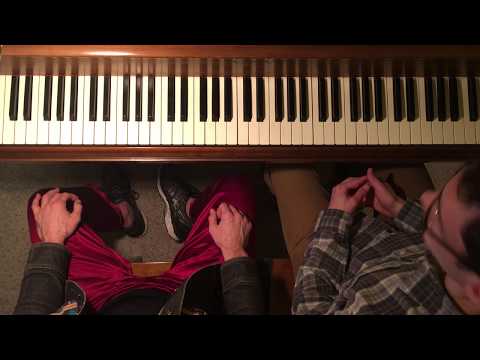
Learn to play jazz piano; a brief overview (42 minutes; watch 00:00 to 07:00 for this lesson)
- [05:00] Drop-2 derived on camera: take the second voice from the top and move it down an octave. That is a rotation of registral position, which the source course names directly as the jazz version of Stravinsky's operation.
- [06:03] His historical framing: "it's descending in a way that is done throughout the history of western music that you can see in chorales and even stuff before that."
- [06:18] The options past four voices, a fifth voice or the Herbie voicing with octaves up. Each is a different reading of one collection.
- [03:25] Economy of motion as the criterion for choosing. Keep it when you pick a path through your array.

How to Become a Well Rounded Jazz Pianist (in 42 minutes)
- [21:37] The drop-2 conversion stated as a pattern, and at [22:02] applied to a voice-led sequence. A sequence of rotated voicings is a horizontal reading of a vertical operation, which is the whole geometry of this lesson.
- [14:10] The tritone as the engine of the circle of fifths. Keep it in mind when your array's columns produce collections with two tritones in them, because they will.
Listen
Pass 1, surface. Movements for Piano and Orchestra, second or third movement. Do not analyze. Three adjectives. The source course's sample set for Stravinsky is "angular, lapidary, stark."
Pass 2, structure. Same movement. Listen for the joins. Sections follow one another with no transitional material, exactly the way the blocks of The Rite of Spring are juxtaposed. Mark the seams.
Pass 5, relationships. Listen for register. Stravinsky fixes pitches in specific registers rather than freely respacing them, unlike Schoenberg and Webern. Follow one pitch class and find where it lives.
Pass 1, modern side. "Lethargica," riff entry. Olivia Lucas documents this as a rotated riff, a looping riff whose internal durational pattern makes it sound as if it begins in the middle. Try to find the beginning. Then try "Pineal Gland Optics" and "Pravus," which has two of them.
Sing. Sing the six-note cell C, D♭, F, G♭, A, B♭. Then sing it starting from its second note, then its third, and so on, six times, without transposing. Then do it again transposing each rotation back to C. The second version is the array.
Tap. Over "Lethargica," tap four steady beats to the bar. Lucas's finding is that Meshuggah builds songs in segments of eight, sixteen or thirty-two bars of 4/4, and the looping riffs fall in and out of alignment with that background but rarely overcome it. The riff gets truncated wherever it happens to be at the end of the segment, and that truncation is the form-generating event.
The comparison
The parallel, stated narrowly. Both practices take a fixed ordering and cycle its starting point. Stravinsky rotates an ordered hexachord and then transposes each rotation back to the original first pitch, generating a grid whose columns yield harmonies unavailable through the standard serial operations. Lucas's rotated riff is a looping riff arranged so that its perceived beginning is displaced from its actual beginning, which forces the listener to re-orient and weakens the sense of where the segment boundary falls. In both cases a cycle is entered at an unexpected point and the result is new material rather than a restatement.
Where it breaks, and it breaks hard. Stravinsky's rotation is a pitch-class operation on an ordered series, and the transposition step is what makes it productive. There is no transposition step in Meshuggah, and there is no pitch-class operation at all. The rotated riff is a durational and metric phenomenon. Its pitch content does not change when it rotates. So the two practices share the English word and almost nothing else.
The second break, about what is recoverable. Edward Cone distinguishes the temporal beginning of a passage from its rhythmic beginning, and the rotated riff is exactly a passage where those two are deliberately misaligned. But in Cone the tonal syntax and phrase rhythm make a true beginning recoverable. In Meshuggah there is no syntactic evidence for a correct orientation, so the ambiguity is permanent rather than retrospectively resolved. Stravinsky's arrays, by contrast, are entirely recoverable, because the composer has the grid on his desk.
The third break, about the background. The background pulse never changes in Meshuggah and it always changes in Stravinsky. Stravinsky renotates the meter bar by bar, 5/8, 7/8, 3/16. The bar itself is the composed object. In Meshuggah the bar is a fixed container and only its contents move. That difference is why an audience can count in the balcony while the pit moshes to the same music, and it is the single most important thing to understand about the two repertoires.
What you actually take from this. Use the array for pitch. Use Lucas's rotated riff for rhythm. They are two separate tools that happen to share a name, and using them together in one piece is a good idea for exactly that reason.
At the piano
Build the array from the source course's own exercise hexachord, C, D♭, F, G♭, A, B♭. In pitch-class integers that is 0, 1, 5, 6, 9, 10. Rotate six times, transpose each rotation back to C, and you get this grid, which you should derive yourself and then check against:
| Row | Pitches | Integers from C |
|---|---|---|
| 0 | C D♭ F G♭ A B♭ | 0 1 5 6 9 10 |
| 1 | C E F A♭ A B | 0 4 5 8 9 11 |
| 2 | C D♭ E F G A♭ | 0 1 4 5 7 8 |
| 3 | C E♭ E F♯ G B | 0 3 4 6 7 11 |
| 4 | C D♭ E♭ E A♭ A | 0 1 3 4 8 9 |
| 5 | C D E♭ G A♭ B | 0 2 3 7 8 11 |
Play each row as a melody, slowly, right hand alone. Six melodies, all starting on C, all from one source, all with different directional tendencies.
Now read down. Column 1 is six Cs, which is trivial by construction. Column 2 gives D♭, E, D♭, E♭, D♭, D, a chromatic cluster on {1,2,3,4}. Column 3 gives F, F, E, E, E♭, E♭, which reduces to {3,4,5}. Column 5 gives {7,8,9}. Column 6 gives {8,9,10,11}. Several of your verticals are three- and four-note chromatic clusters, which is a hexachord-specific result, not a general one. Change the starting hexachord and the columns change character completely. That is the experiment.
Play the columns as chords, both hands, and voice them the way you would voice anything. Then apply drop-2 to each, exactly as Greg derives it at [05:00], and hear the same collection become a different chord.
For your left hand, take one column as a fixed voicing and hold it for four bars while the right hand plays one of the rows as a melody over it. That is a complete piece of music and it is playable this week.
Exercises
1. Build your own array from scratch
Do. Choose six pitches in a specific order, not the course's. Write all six rotations. Transpose each rotation to begin on your first pitch. Arrange in a 6x6 grid. Do it on paper, then enter it in Sibelius.
Done when: The grid is complete, every row begins on the same pitch, and you have checked one row's arithmetic twice independently.
2. Six melodies
Do. Play each row as a melody at the keyboard, slowly, with a rhythm you choose. Notice which rows want to rise and which want to fall.
Done when: You can play all six from the page without hesitation and can name which two are the most different from each other and why.
3. Six chords, then twelve
Do. Play each column as a simultaneity. Then produce a drop-2 version of each. Record all twelve, four beats each, in sequence.
Done when: Twelve chords are recorded and you can name three of them as things you would actually use.
4. Rotate a six-note riff into verticals, the Stravinsky way
Do. Take a six-note riff you have already written, in your own tuning and register. Treat its six pitch classes in their original order as the hexachord. Build the array. Read the columns. Voice those columns for two guitars and bass, and write a progression from them under the original riff.
Done when: The riff and the progression are recorded together, and the progression contains at least two chords you would not have written by ear.
5. Rotate the same riff the Meshuggah way, and hear the difference
Do. Take the same riff. Leave the pitches alone. Re-arrange its internal durations so the loop sounds as if it starts in the middle. Loop it over a steady 4/4 drum pattern for eight bars, and truncate it wherever it lands at the end of bar eight.
Done when: A listener taps a downbeat that is not the riff's actual beginning, and you can write one paragraph on why exercise 4 and exercise 5 are unrelated operations despite the shared word.
6. The registral-fixity drill
Do. Take one array column and fix each pitch in a specific octave. Play a two-minute improvisation over a pedal in which those pitches never leave their assigned registers.
Done when: You can hear the collection as a fixed object in space rather than as a chord you can voice any way you like.
Compose
Write a three-minute instrumental in block form. Constraints: three or four self-contained blocks, no transitional material between them, all pitch material drawn from one rotational array, and at least one block whose harmony comes from the array's columns rather than from your ear. One riff in the piece must be rotated in the Meshuggah sense as well, so that the piece uses both operations and you can hear that they do different jobs.
Where the array suggests one pitch and your ear hears another, take the note your ear hears and mark it. Straus documented Stravinsky doing this constantly in Stravinsky's Late Music, and the source course's reading is the right one: those are not mistakes, they are moments where the ear overrules the system. Keep a list. It is a record of what your taste actually is.
Checkpoint
- One array of your own, built on paper and entered in Sibelius, arithmetic checked twice.
- Six rows played as melodies, six columns played as chords, twelve chords recorded including drop-2 versions.
- One of your own riffs rotated the Stravinsky way into a progression, recorded with the riff.
- The same riff rotated the Meshuggah way, looped and truncated over 4/4.
- Your paragraph on why the two operations are unrelated.
- The three-minute block-form piece, with your list of places where your ear overruled the grid.
Read
- Source course, Lesson 21, complete. The five steps of the array, horizontal and vertical reading, the four persisting Stravinskian traits (block form, rhythmic vitality, registral fixity, repetition), and the treatment of serial mistakes. /library/garnett-course.pdf
- Straus, Stravinsky's Late Music (Cambridge, 2001). The documentation of where Stravinsky departs from strict procedure. Read it after you have built an array, not before, so the departures mean something.
- Lucas, MTO 24/3 (2018), https://mtosmt.org/issues/mto.18.24.3/mto.18.24.3.lucas.html. The rotated riff, the eight/sixteen/thirty-two-bar segment structure, and the spectrogram-plus-transcription method. Note that she alternates spectrograms with conventional notation because each shows different things about what counts as a musical event. That argument matters for your own transcription work.
- Cone, Musical Form and Musical Performance (Norton, 1968), on beginning, middle and end as functions rather than positions. This is the classical source behind the second break in the comparison above.
- Osborn, MTO 17/3 (2011), https://mtosmt.org/issues/mto.11.17.3/mto.11.17.3.osborn.html, for "independent verses," the concept Lucas cites to explain why Meshuggah's segments do not behave like verses.