The idea
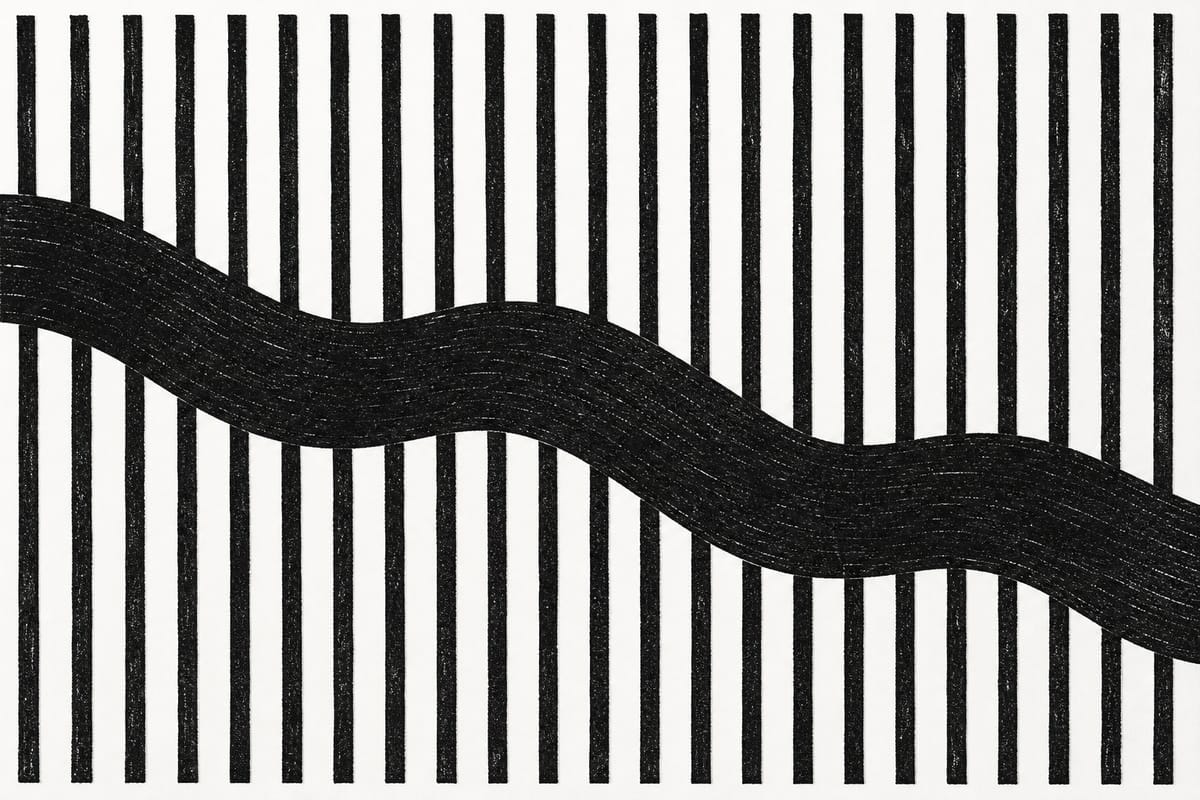
There are two completely different ways to break time, and almost everyone confuses them.
The first way changes the container. Stravinsky writes 5/8, then 7/8, then 3/16. The bar itself is the composed object, and there is nothing steady underneath for you to hold onto.
The second way keeps the container and changes what you pour into it. Meshuggah's guitars, bass, and kick state a riff whose cycle is an odd number of sixteenths. The drummer's cymbal hand and snare never leave 4/4. The riff rolls across the barline, re-phasing a little further each time, until the two cycles land together again at their least common multiple. Jonathan Pieslak named this metric superimposition in 2007, and it is the founding idea of the whole modern rhythm literature.
Hold that difference. It is the difference between losing the floor and watching something skid across a floor that never moves.
Watch
USE A METRONOME!
- The rule at [00:00] applies to every exercise in this module.
- [00:05] is the whole point: "you want to be feeling the time along with the metronome and not relying on the metronome, but developing that inner pulse." A superimposed layer is unhearable if the grid is not already inside you.

For Musicians - Improve Your Time
- Greg sets a metronome at 104, then turns the quarter notes off and leaves only the accented downbeat. You clasp your fingers on beat one while feeling every quarter internally.
- He deliberately picks a non-round tempo: "I try to make it random every time so that I don't get calibrated to only feel a certain tempo." Do not practice this module at 60, 100, or 120.
- He drops to 73 to make it harder. Slower is harder, always.
- Dosage: he did it for an hour and a half in one sitting. You are doing five to fifteen minutes, daily.

Good Time and Feel: The Time Stack
- The four layers at [09:14]: consistency, precision, flexibility, subtlety. This module lives in layers one and two.
- [02:24] Pro Metronome with beats progressively muted, eyes closed. This is the drill that builds the 4/4 background you will need to hear Meshuggah's grid.
- [03:26] do it at 80 or 90, then at 40. "It gets a lot harder at 40."
- [05:05] precision: play scales on the sixteenth immediately before or after the beat. That displacement is the same mental operation as tracking a riff that has slid one sixteenth off the grid.
Listen
"Bleed," obZen (2008).
Pass 1 (surface). Play 0:00 to 2:15. Do nothing but tap quarter notes with your foot. Do not try to follow the guitar.
Pass 2 (structure). Same span, foot still on quarters, now count "1 2 3 4" out loud continuously without ever restarting the count to match the guitar. You will feel the guitar figure and your count agree, then disagree, then agree.
Pass 5 (relationships). Lucas gives a timestamped account of what carries the 4/4 as the track proceeds, and it is the single most useful listening map in the literature. The cymbals state 4/4 clearly until roughly 1:25. At about 1:25 the drums move to eighths with a popping kick. Around 1:40 the cymbals join the new pattern, leaving the vocals to carry the 4/4. From about 1:58 the lead guitar marks the downbeats. Listen five times and each time name out loud which instrument is currently holding the grid. The grid never disappears. It changes custody.
Then sing the riff's cycle on a single pitch, in the riff's own grouping, while your foot keeps quarters. That is the exercise. Everything else in this lesson is scaffolding for it.
"Augurs of Spring," The Rite of Spring. Tap quarters. You will fail, and the failure is the lesson. Source course Lesson 24 describes Stravinsky's method here as blocks that are "interrupted, not transitioned into." There is no custody chain because there is no fixed grid to hold custody of.
The comparison
The parallel. Both repertoires set a recurring group of x attacks against a metric layer of y, and in both the musical interest lies in the phase relationship over time rather than in the local pattern. Harald Krebs formalizes this for Schumann and Brahms as grouping dissonance, written Gx/y. Pieslak's metric superimposition is the same object: an odd-cardinality riff cycle in the guitars, bass, and kick against an unbroken 4/4 in the cymbals and snare, analyzed with attack-point interval analysis after Maury Yeston plus Joel Lester's textural accent. The source course teaches the same thought at Lesson 5, where Babbitt's parametric dissonance extends the tension-and-resolution model from pitch to rhythm: a complex, irregular rhythm following a regular one is a dissonance, and it wants to resolve.
The break, stated three ways.
Krebs's dissonances resolve; Meshuggah's arrive. In Schumann the composer aligns the layers at a cadence and harmonic syntax carries the form. Meshuggah has no harmonic syntax to resolve into. The alignment point is arithmetic, not cadential. The "resolution" is the least common multiple of the two cycle lengths coming due.
Meshuggah is not Stravinsky, and this is the error the internet makes most often. Lucas documents that Meshuggah "builds songs in segments of eight, sixteen, or thirty-two measures of 4/4," and that the looping riffs "fall in and out of alignment with this background structure, but rarely overcome it." The riff is cut off wherever it happens to be when the hypermetric segment ends, and that truncation is the form-generating event. Stravinsky renotates the meter bar by bar, so the bar itself is composed. Pieslak's own structural point says the same thing from the other side: the odd riff is bounded by a symmetrical hypermeter, so the irregularity is always a foreground event over a regular background.
The drummer's job is opposite in each case. Tomas Haake has said in interviews that everything is built on a 4/4 platform and that he plays eighths on the hi-hat so everyone can headbang, and that riffs of thirteen or seventeen notes simply roll over the barline. Garza 2021 formalizes exactly this function: the timekeeping cymbal exists to declare the tactus and cue entrainment even when everything else is syncopated. A Stravinsky percussionist has no standing layer to maintain, because the ensemble's accents are the meter.
The consequence. In Stravinsky your tactus is genuinely displaced and there is nothing to count against. In Meshuggah you can always count 4/4, which is why an audience can simultaneously count in the balcony and mosh in the pit to the same music. When you write in this idiom, decide which of the two you are doing before you write a bar. They are not two settings of one dial.
One honest limit. Capuzzo's 2018 article is the follow-up to Pieslak and its frame is deviance from analytic yardsticks at the micro level, drawn from six songs. The identity of those six songs and his named taxonomy of deviance categories sit behind a paywall and were not retrieved for this course. Do not learn a list of "Capuzzo's categories" from a secondary summary. Read pages 121 to 137, with the corrected Example 12, before you build on it.
At the piano
You will build the grid in your left hand and the superimposed cycle in your right. Use one pitch class per hand at first. Pitch is a distraction here.
The grid. Left hand, low C octave, straight quarter notes, metronome at 87. Not 80, not 90. Follow Greg's rule about non-round tempi.
The cycle. Right hand, a single note two octaves up, playing a repeating group of five sixteenths against the left hand's quarters. Five sixteenths against a bar of sixteen sixteenths re-aligns after five bars (LCM of 5 and 16 is 80 sixteenths). Count the eighty. Land together.
Then seven. Seven against sixteen re-aligns after seven bars. This is where it stops being arithmetic and starts being a feel.
Then thirteen and seventeen, which are the numbers Haake names. Thirteen sixteenths against 4/4 re-aligns after thirteen bars. Seventeen after seventeen. If you can hold seventeen bars of 4/4 with your foot while your right hand cycles seventeen sixteenths, you have the physical apparatus this entire module needs.
Voicing, once the counting is solid. Left hand: root and fifth, low, on quarters. Right hand: a stacked fourth or a minor second dyad, so the cycle has a color that cuts. Meshuggah's harmony is not the point and you should not try to make it one. Pitch here is a marker for attack.
Exercises
1. Custody chain
Do. Play "Bleed" 0:00 to 2:15 five times. On each pass, say out loud, in real time, which instrument is currently carrying the 4/4. Write your five passes down.
Done when: Your written answer matches Lucas's account at 1:25, 1:40, and 1:58 on three consecutive passes without looking at the article.
2. Muted-grid ladder
Do. Pro Metronome at 87, eyes closed. Play the C octave in quarters for 32 bars. Mute beats 2 and 4. Repeat. Mute all but beat 1. Repeat. Then drop the tempo to 43 and run the whole ladder again.
Done when: At 43 with only beat 1 sounding, the click lands where you expect it on all 32 bars, twice in a row.
3. Five, seven, thirteen, seventeen
Do. Left hand quarters at 87. Right hand cycles a group of 5 sixteenths. Count out loud to the re-alignment and stop exactly there. Repeat with 7, then 13, then 17.
Done when: For each cycle length you can state the number of bars to re-alignment before you play, and land the two hands together on that downbeat three times running.
4. Write one superimposition
Do. In Sibelius, notate 16 bars of 4/4. Put a hi-hat on eighths and a backbeat on 2 and 4 for the whole 16 bars, unchanged. Above it, write a guitar and bass riff whose cycle is 11 sixteenths, looping continuously and truncated wherever bar 16 ends.
Done when: The score shows the riff cut off mid-figure at the end of bar 16, the drum part is identical in all 16 bars, and you can play the drum part with your hands while singing the riff.
5. The Stravinsky control
Do. Take the same 11-sixteenth riff. Renotate the passage so that every statement of the riff gets its own bar of 11/16, and delete the fixed backbeat entirely.
Done when: You can play both versions back to back and state, in one sentence each, what the listener can count in version A and what the listener cannot count in version B.
6. Parametric dissonance, at the keyboard
Do. Improvise 16 bars over a static one-chord vamp, quarter notes only, absolutely regular. At bar 17, switch to a 7-sixteenth cycle over the same vamp for 7 bars, then return to quarters.
Done when: A listener with no theory can point at the moment tension enters and the moment it leaves.
Compose
Write a 32-bar instrumental section for guitars, bass, and drums (or piano reduction plus drums), notated in Sibelius, under three constraints.
- The drums state an unbroken 4/4 for all 32 bars. The kit part may change texture once, but the tactus layer must never stop being countable.
- The riff cycle is a prime number of sixteenths other than 5 or 7, stated by guitar, bass, and kick together.
- The section ends at bar 32 regardless of where the riff is. Cut it off mid-figure.
The one technique that must be audible: a listener tapping quarters should be able to tap through the entire section without ever being wrong.
Checkpoint
- Play "Bleed" and name the custody chain in real time.
- Hold 17 bars of 4/4 with the foot while cycling 17 sixteenths with the right hand.
- State the LCM re-alignment point for any cycle length against 4/4 without a calculator.
- Explain in two sentences why Meshuggah's technique is closer to Krebs's grouping dissonance than to Stravinsky's additive meter, naming the fixed 4/4 background as the reason.
- Hand in the 32-bar section with a truncated riff cycle and a drum part you can play.
Read
- Pieslak 2007, pages 219 to 245, with the extended analysis of "I" at 223 to 242. The founding article. Read it for metric superimposition and for attack-point interval analysis after Yeston.
- Lucas 2018, in full and free online. Read it for the segment structure of eight, sixteen, and thirty-two bars, and for the "Bleed" timestamps you used in the listening protocol.
- Capuzzo 2018, pages 121 to 137, obtained through a library, plus the corrigendum at page 177. Read it after Pieslak, and read the actual pages rather than any summary.
- Garza 2017, abstract and the chapters on preference-rule systems. Read it for why the borrowed classical tools misfire in a repertoire with no harmonic syntax, and for the timekeeping-cymbal function.
- Krebs 1999, pages 31 to 32, for grouping dissonance and the cycle. Short, and it is the vocabulary the whole modern literature uses.
- Source course, Lesson 5, on parametric dissonance and form as process. This is where the course itself gives you permission to treat rhythm as the carrier of tension.