The idea
Most virtuosic music is boring for one reason. The fast part is an insert. The composer writes a piece, drops in a passage whose only content is that it is hard, and the piece resumes unchanged. Cut the passage and you lose nothing.
The virtuosic music that lasts does the opposite. The fast passage is where the material gets developed hardest, so cutting it collapses the form. Ligeti's Étude No. 1 is unplayably fast and the speed is the subject, because two hands drift apart when one keeps losing a beat. Nancarrow's canons are impossible for human hands and the impossibility is the structure. Hamasyan's hardest passages are hard because two meters run at once, which is a formal fact and not a finger fact.
So the test, every time you write something fast: what is this passage a development of, and what happens to the form if I delete it? No answer means you wrote decoration.
Watch
Learn to play fast
- The caveat is the first thing he says, at [00:22]: "speed means nothing without musicality." That is this lesson in six words.
- The touch, at [01:11] and [01:33], from Herbie Hancock directly. Relax the hand, and as the next key goes down the previous finger lifts, so the fingers work in counterpoint. "You're barely putting any pressure on. It's like a flutter" [01:44].
- The lick at [04:25]: four pentatonic notes up, restart one pentatonic note lower, continue, then reverse. Metronome at 45 on eighth notes [04:52]. He credits it to Chick Corea [04:19].
Play arpeggios and shapes fast and with musicality
- The fingering law, at [01:51]: "in any arpeggio you want to find the shortest point between two notes and make that the point where you cross your thumb under." Everything else follows from that sentence.
- The exercise at [02:08]: a dominant chord as 3, 5, 7, 9, up and down the whole keyboard, every key, at 40 bpm with the fingers relaxed [02:42]. The Oscar Peterson enclosure of the fifth follows at [05:46].
- The analysis at [07:23] is the composer's part. Over a ii-V into the four, a C minor arpeggio reaches an F sharp-five and lands on D, the third of B flat. The ear likes it because the line ends a whole step from where it started, so it neither repeats its origin nor loses it.
How to play Shapes and Enclosures (fast)
- Two reasons a fast shape works, at [01:54] and [02:26]. Deception, the line overshoots the note you expected and corrects downward. Return, it comes back to the note it started on.
- At [02:29]: "you're basically creating a goal point when you start. No matter what you're doing, when you start, that's one of the notes that sticks in your memory."
- The enclosure spelled out at [04:14], the blues drill at [04:52], and at [05:23] the warning that the drill is not the music. At [06:49], the principle behind every wide fast piano line: keep the whole octave available to the hand.
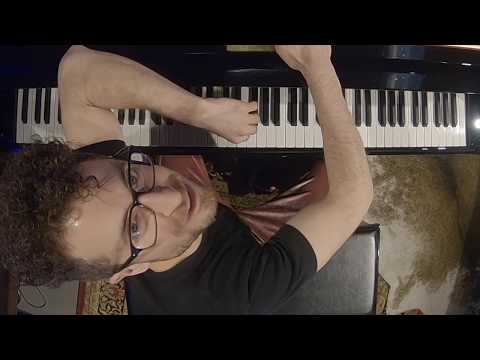
Tigran Hamasyan Transcription
- An hour of unedited work on one line from For Gyumri, at 2:55 in the track [01:07], piano into Sibelius by MIDI.
- The rhythmic discovery: the left hand is an ostinato written in 6/8 that is really 12/8 [04:56], with the right hand grouping in fives across it [01:50]. Three groups of five fill the rest of the bar, so the phrase runs 15 beats, 12 plus 3, and lands back on beat one [07:36].
- The finding that matters most, at [15:48]. He counts the phrase lengths and gets 5, 5, 5, 6, 7, 6, 5. The line grows and then shrinks. At [18:22] he names the device: patterns built on an increasing number of notes per phrase, over an ostinato. That is virtuosity organized as a shape.
- The pipeline at [01:06:22]: up to speed from 20 bpm, hands together and separately, add the ostinato, learn it in all keys, invert it, all keys again.
- On touch, at [40:55]: "when you have a light touch you can play more notes faster and more precisely."
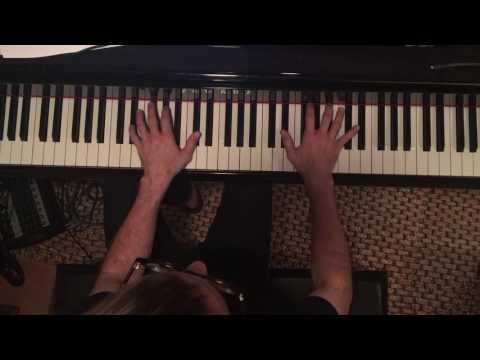
Chick Corea Matrix Exercise and Fast Scales
- No usable captions exist for either. Watch the hands and copy what you see. Pair the Matrix video with the recording, a fast B flat blues from Now He Sings, Now He Sobs (1968).
Fast Scales
- scales at speed; the transcript is unrecoverable, so treat it as a demonstration to imitate
Listen
Pass 1, play each once straight through doing nothing. Pass 2, structure:
- Nancarrow, Study No. 36. Tempo ratios 17:18:19:20, four voices at four almost identical speeds. Listen for the moment you stop hearing four lines and start hearing one texture. That transition is the form.
- Nancarrow, Study No. 21, "Canon X." One voice accelerates, one decelerates, and they cross in the middle. The crossing is the only structural event, and you can hear exactly when it happens.
- Ligeti, "Désordre." Right hand only white notes, left hand only black, producing what Steinitz calls a "combinatorial tonality." From bar 4 Ligeti deletes one quaver from the right hand every fourth bar, so the top line runs progressively ahead of the bottom. Follow the accented, octave-doubled top notes and you hear a phrase group iterated fourteen times, each restatement one step higher. Exercise 3 has the full mechanism.
- Ligeti, "Automne à Varsovie." Notated in 4/4 with sixteen fast pulses per bar. At one point the right hand accents every fifth pulse and the left every third, and Ligeti says the ear fuses the accent chains into "a super-signal consisting of two melodies." Hear the 5 and the 3 as two tempos, not one rhythm.
- Hamasyan, "Drip," 1:32 to 1:58. Schumann's transcription finds the melody's 4/4 against an accompaniment in an 8:5 ratio, producing an implied 5/4 with seven shared alignment points. Layer 2 then breaks its own pattern early so the four-bar hypermeasure survives.
- Hamasyan, "Song for Melan and Rafik," from 3:44. Layer 1 is an eight-bar unit of seven 5/8 bars plus one 7/8 bar on a C center, against a 12/8 backbeat. Layer 1 repeats twice while Layer 2 repeats seven times before they realign.
Pass 5, after a week, with one question: in each piece, does the difficulty come from the structure or from the surface. Then tap the steady layer of "Song for Melan and Rafik" with your left hand while singing the melody, before you try to play it.
The comparison
Comparison one. The virtuoso-composer.
The parallel. Paganini and Liszt belong to a tradition in which technique and compositional identity develop together and the instrument's affordances drive what gets written. DePue's 2022 dissertation argues the same model for rock guitar from Van Halen to Guthrie Govan: players develop a personal integration of technique, sensibility, and gear, and that integration is their compositional voice.
Where it breaks. Liszt's innovations entered a notated repertoire any other player could pick up. Rock guitar technique travels through recordings, video, and gear replication, so "style" includes the signal chain in a way no classical parallel captures. Source caution: DePue is musicology and historiography, so cite it for how a style forms, never for measure-level analysis, because it contains none.
Comparison two. The fugue.
The parallel. Ligeti named "Automne à Varsovie" a tempo fugue himself. One pulse-subject stated at multiple simultaneous rates, with the form being the accumulating divergence of those entries. That is a stretto whose interval of imitation is tempo rather than pitch and time. Taylor documents Ligeti's stated goal: "to produce a rhythmic complexity comparable to Nancarrow's using only a single, living interpreter."
Where it breaks. A Bach fugue's entries are heard as discrete statements of a subject. Ligeti's voices are never played at all. They are inherent patterns your ear assembles out of accent chains, so there is no subject to track and no possible answer, inversion, or episode.
Comparison three. Metal's borrowed virtuosity.
The parallel. Metal's virtuosic apparatus is genuinely the Baroque and Classical apparatus. Power metal uses secondary dominants and applied diminished sevenths as modulation devices, and the corpus study establishing this cites Walser and Lilja by name for metal's affinity with Bach and Mozart. Lilja argues Deep Purple and Dio era harmony sits closer to Baroque and Renaissance practice than to the pop music of its own decade.
Where it breaks. Those devices carry rhetorical weight, not structural weight. They color a progression and signal genre membership. They do not organize the song's long-range tonal plan the way the same devices organize a sonata exposition.
Source note. Walser's Running with the Devil (1993) is the standard citation here. The research behind this course verified it only as cited by name, title, and year inside Boddington Jordan and Herbst 2023, not at page level. Treat any page-specific claim from it as to verify.
Comparison four. Thordendal and the octatonic.
The parallel. Fredrik Thordendal's lead style descends from Allan Holdsworth's legato, long slurred lines with minimal picking, over Meshuggah's rhythmic substrate, with a vocabulary centered on the symmetrical diminished scales grouped in sevens and fives per string against a 4/4 substrate. That is the same collection as the octatonic in Rimsky-Korsakov, Stravinsky, and Messiaen's mode 2, used for the same reason: its symmetry makes every transposition sound destination-free, which suits music with no functional harmony.
Where it breaks. Stravinsky exploits the octatonic's invariant subsets to build harmonic areas. Thordendal uses it as a linear pattern generator, so it organizes figuration rather than structure. Status warning: no peer-reviewed analysis of his playing exists, so all of that is interview and transcription evidence, to verify before you assert it as fact.
At the piano
Two problems get solved at once here: tension, and a left hand that cannot support the right.
The touch. Sándor reduces all pianistic motion to five patterns: free fall, the five-finger and scale and arpeggio complex, rotation, staccato, and thrust. That is the best map in the literature for someone who has to invent fingerings for music nobody has fingered before. Thrust is the one to know here, an actively pushed stroke used where free fall cannot deliver the speed or attack. Greg's flutter is the five-finger complex run with minimal vertical excursion, which is why it and Tigran's light touch describe the same thing.
What the measurements show. Furuya and Kinoshita find that experts generate more torque at the shoulder and exploit interaction torques at elbow and wrist while reducing distal muscular work, and that maximum striking tempo tracks elbow velocity, not finger velocity. Power and speed come from the proximal chain, stability and articulation from a structurally organized hand, and neither substitutes for the other.
One belief to drop. Ortmann measured with a dynamograph at the Peabody Conservatory and found rigidity produces greater key speed than relaxation, and that fortissimo was unobtainable with fully relaxed production. Relaxation is the absence of unnecessary exertion and nothing more. Shaking out the tension means removing exertion that is not doing work.
One belief to keep, for the right reason. Askenfelt and Goebl found the string's spectrum does not change at equal hammer velocity, but the audible tone does, through finger-key noise, key-bottom noise, and a 30 to 40 millisecond timing difference between a struck and a pressed attack. Remove the attack noises from a listening test and the discrimination vanishes entirely. Your touch is audible, in the noise around the note.
The daily work.
- Dominant-nine arpeggios, 3-5-7-9, four octaves up and down, all twelve keys, thumb crossing at the shortest interval, from 40 bpm, raised only after a clean repetition.
- The flutter drill, two-finger alternation with no arm involvement, extended to five fingers, then to the pentatonic sequence at 45 bpm.
- The enclosure of the fifth in all twelve keys, then the one, the three, and the seven.
- Left hand alone, everything above, at half the right hand's tempo. It is the bottleneck, and every fast passage you write is limited by it until it is not.
- Chick Corea's image, from A Work in Progress: fingers as drumsticks. He also says there that good control of rhythm is the single most important element in making good music, which puts speed under rhythm instead of under strength.
Neuhaus's ordering governs all of it. The sound you want dictates the motion. That is the composer's relationship to technique, and it is why this lesson sits in Part B.
Exercises
1. Delete the passage
Do. Find three fast passages in music you love, at least one from a band. For each write two sentences: what material it develops, and what the piece loses if you cut it. Then find one where the honest answer is "nothing."
Done when: you have four written verdicts, including the negative, and can defend each.
2. Grow and shrink
Do. Put a two-bar 12/8 ostinato in the left hand and a right-hand figure grouped in fives over it. Write a phrase-length sequence that grows and shrinks, following Hamasyan's 5, 5, 5, 6, 7, 6, 5. Ladder it from 20 bpm through 30, 40, 60.
Done when: you play it at 60 with the ostinato underneath, and can say where each phrase starts relative to the downbeat.
3. The deletion étude
Do. Write eight bars for two hands, eight quavers per bar, right hand accented 3+5, 3+5, 5+3 and left 5+3. From bar 4, delete one quaver from the right hand every fourth bar, as Ligeti does. Engrave it.
Done when: the hands are visibly out of phase by bar 8 on the page, and you can play the first four bars at any tempo where both accent patterns are audible.
4. Two tempos, one motive
Do. Take one three-note motive and write it as a two-voice canon in which the second voice runs at 4/5 the speed of the first, realigning after twenty units. No other material. Play the top voice while a click or a recording carries the bottom.
Done when: you can point to the realignment on the page and hear it in playback.
5. Fast material from a goal-note skeleton
Do. Choose a goal note. Write four bars of sixteenths reaching it on the downbeat of bar 4, using only transformations of one three-note cell plus enclosures of the goal, built as the video builds them.
Done when: a listener who has never seen the page sings the goal note back after one hearing.
6. The passage that is the development
Do. Take the eight-bar sketch from L0 and its motive. Write a 16-bar virtuosic passage in which every figure transforms it: literal inversion in bars 1 to 4, diatonic inversion in 5 to 8, diminution in 9 to 12, fragmentation to a two-note cell in 13 to 16. Greg's two options from A12 apply, so keep the intervals literal, or keep the shape and let the key adjust them, and cycle between the two.
Done when: you play it at half tempo hands separately with no tension, and someone who knows the original eight bars identifies the motive in every four-bar group.
7. Left hand alone
Do. Every exercise above, left hand only, at whatever tempo is clean.
Done when: the left-hand version of exercise 5 matches the right hand's tempo.
Compose
The prompt. 2 to 3 minutes for solo piano, then arranged for your target instrumentation.
The constraints.
- One motive of three or four notes, stated unaccompanied in the first eight bars.
- Exactly one virtuosic passage, 16 to 32 bars, where the form needs its highest intensity.
- That passage is the piece's principal development section. Every figure transforms the motive, and no new material enters.
- Its difficulty comes from a structural source, not finger speed. Pick one: two layers in different meters realigning at a computable point, a phrase-length series that grows and shrinks, or a systematic deletion that puts the hands out of phase.
- The piece resolves afterward in a way that would be unavailable had the passage not happened. Write that down in one sentence.
- Engrave it in Sibelius, record the piano version, then arrange it.
The test before you call it done. Delete the fast passage and play what is left. If the piece still works, you wrote decoration, and you start the passage again.
Checkpoint
- Four written verdicts from exercise 1, including one honest negative.
- The grow-and-shrink sequence at 60 bpm over its ostinato.
- The eight-bar deletion étude engraved and playable.
- The 4:5 canon engraved, realignment point marked on the score.
- The 16-bar motivic passage at half tempo, hands separately, no visible tension and no arm lift on thumb crossings.
- The full piece engraved, recorded at the piano, and arranged.
- The one-sentence answer to "what does the resolution do that it could not have done without the passage."
Read
- Gann, The Music of Conlon Nancarrow (Cambridge, 1995), chapters 6 and 7. The chapter structure is itself the taxonomy of what a tempo relationship can be.
- Gann's annotated works list. Ten minutes, for the ratios of Studies 21, 22, 27, 36, 37, 40, 41, 48, 49. On accuracy: there is no Nancarrow canon at 2:3:4, despite that ratio circulating widely. The nearest real values are 4/5/6 and 3/4/5/6.
- Gann, MTO 20/1 (2014). The 26 ideas Nancarrow used exactly once, and why the late studies superimpose the earlier categories.
- Steinitz, The Dynamics of Disorder. The measure-level account of "Désordre."
- Taylor, MTO 3/3 (1997). The tempo fugue in Ligeti's own words.
- Schumann, MTO 27/2 (2021). The three formal functions of a cycle, phrasal, structural, developmental, which is a composition tool.
- DePue 2022 (PDF), chapters 5 and 6, for how a virtuoso's compositional voice forms.
- Sándor, On Piano Playing. Rotation and thrust. Be skeptical of the singing-tone chapter, which drifts toward touch shaping timbre independently of key velocity.
- Neuhaus, The Art of Piano Playing. For the hierarchy, sound-image first. Its physical prescriptions are thin.
- Corea, A Work in Progress, chapter 5, on time, playing fast, and the drumsticks image.
- Source course, Lessons 23 and 29. Wolpe on weight and tension as compositional parameters, and the motivic improvisation that exercise 6 writes out.