The idea
Most students meet odd meter as a constraint. Five beats instead of four, and the tune limps.
Odd meter earns its place when the melody could not exist in four. The cycle stops being a container and becomes part of the tune's shape. Scott Schumann's study of Tigran Hamasyan is the best-documented case in print: he transcribed everything himself and counted 39 metric cycles across 137 tracks on 13 albums, 2006 to 2020.
The second half of this lesson is a discipline rather than a technique. Odd meter attracts numerology like nothing else in music, and the Lateralus Fibonacci story is the case study. You will learn to say what is documented and what is not, and to notice that the real part is smaller and better than the myth.
Watch
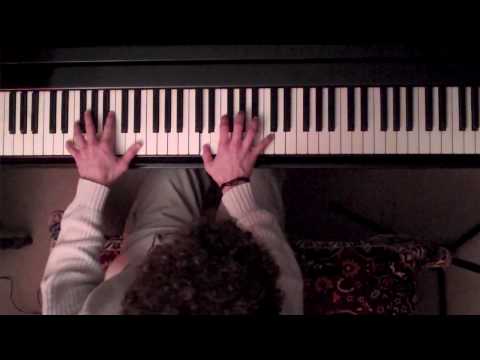
Blue in Green (in odd time)
- Performance only, no talking. Blue in Green is normally a floating 4/4 ballad with a famously ambiguous ten-bar form.
- Track how the melody's long notes are re-placed against a cycle that will not divide evenly, and where the harmonic rhythm stretches to fit. That stretching is the compositional work of a re-barring.

Tigran Hamasyan Transcription
- [04:56] the left hand is an ostinato in 6/8 that is really 12/8. [01:50] the right hand groups in fives.
- [07:36] to [08:13] the arithmetic on camera: three groups of five fill the rest of the bar so the next phrase starts on beat one, a 15-beat phrase built as 12 plus 3. "It twists the brain."
- [15:48] the phrase lengths grow and shrink: 5, 5, 5, 6, 7, 6, 5.
- [19:34] to [20:34] the harmony: D minor pivoting up a half step to E♭ minor, the F acting as the nine of E♭ minor and as its minor third.
- [40:55] on touch: "when you have a light touch you can play more notes faster and more precisely."
- [01:06:22] the pipeline for any transcribed line: up to speed, hands together and separately, add the ostinato, learn it in all keys, then invert it and repeat.
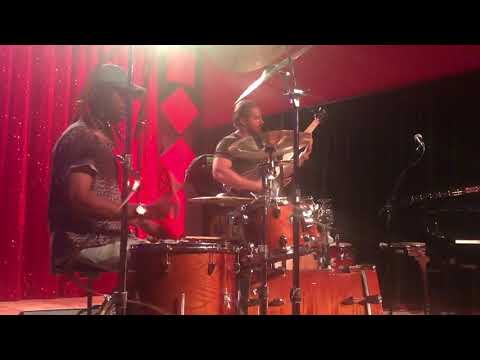
Polyrhythmic 17/16 groove
- Performance only. Seventeen sixteenths is one longer than a bar of 4/4, which is why the groove feels familiar and keeps sliding. Listen for the right hand phrasing across the extra sixteenth rather than pausing for it.
Listen
"Song for Melan and Rafik," Mockroot (2015), track 2.
Pass 1. Listen through once. Do not count.
Pass 2. Find the eight-bar unit Schumann describes: seven bars of 5/8 plus one bar of 7/8, on a C center. Count it once correctly and you own the piece.
Pass 5. From 3:44 a 12/8 backbeat enters as a second layer. Schumann's finding: layer one repeats twice while layer two repeats seven times before realignment. Sing layer one while tapping layer two.
"Drip," Shadow Theater (2013), track 4. The melody is in 4/4 against an accompaniment at an 8:5 ratio implying 5/4, with seven shared alignment points across 1:32 to 1:58, after which layer two breaks its own pattern so the four-bar hypermeasure survives. Schumann calls a cycle like that incomplete.
"Lateralus," verse vocal entry. Count syllables out loud with the recording: "black, then, white are, all I see, in my infancy, red and yellow then came to be." The groupings are countable by anyone with the record: 1-1-2-3-5-8-5-3. The instrumental parts around the verse move between 9/8, 8/8 and 7/8.
Don Ellis, "Strawberry Soup" (1971). Fenlon's central example. Listen for irregular subdivisions inside exotic meters.
The comparison
Parallel one: Hamasyan's cycles and Krebs's grouping dissonance. Schumann's apparatus is Krebs's grouping dissonance and cycle, plus Gretchen Horlacher's definition of a cycle as "a larger, determined duration during which two or more ostinati play out with no vertical repetition." Cycles are complete (both layers run undisturbed to realignment) or incomplete (one cut short to protect the hypermeter), and by function phrasal (a tension-building bridge, the most common), structural (dissonance across most of the piece), or developmental (an opening ostinato returning late against a second layer, often diminuted 5 to 4 or 7 to 5).
Where it breaks against Meshuggah. Meshuggah's background 4/4 is inviolable, from L6. Hamasyan's is not. He notates two meters and often cuts a cycle short so a four-bar hypermeasure survives: a composer intervening in a process, not a fixed grid holding custody.
Parallel two: Armenian modal practice and Messiaen's modes of limited transposition. Both treat a fixed modal inventory with codified ornament rules as the generative constraint in place of functional harmony. Hamasyan's own byline carries the load-bearing claim: "Folk songs have more complex rhythms, as their texts are less restrictive, while religious chants follow specific prose texts, limiting rhythmic freedom." In a 2015 interview he adds that "all the songs are based on modal rules and on chants you can't use certain rhythmic ideas or ornamentation."
Where it breaks. Messiaen's modes are invented symmetrical constructions with no text governing them. The sharakan modes are inherited practice in which the prose text restricts rhythm. That is a verbal constraint, not an intervallic-symmetrical one. Borrowing "modal rules restrict rhythm" as a device means borrowing a mechanism whose original cause you do not have.
Parallel three: odd-meter jazz and Stravinsky's additive practice. Nicholas Abbey's study of Avishai Cohen contributes one defined term: "parallel meters," the juxtaposition of two or more meters of the same temporal length with the same basic subdivision, restricted to structures the composition establishes, which keeps it distinct from ordinary cross-rhythm. His catalogued devices include 4/4 phrasing inside 6/4, long and short meters, expansion and contraction, and rhythmic motivic development.
Where it breaks. Stravinsky's regroupings are composed once and fixed in the score. Cohen's parallel meters exist to be improvised against in real time, which makes the metric structure a shared performance frame rather than a compositional result. The constraint is ensemble legibility. A cycle a band cannot count together is not a cycle.
The Lateralus problem, and how to write about music honestly
This section is technique, not trivia. Learn the shape of the argument and you will apply it for the rest of your life.
What is documented. In the verse of "Lateralus," Maynard James Keenan's vocal phrases are grouped in syllable counts that follow a Fibonacci-like sequence, widely read as 1-1-2-3-5-8-5-3, and the counts are audible and countable from the recording. The surrounding instrumental parts move between 9/8, 8/8 and 7/8, which is the source of the band's own nickname for the song, "9-8-7."
What is not documented.
- No spiral, golden-section, or whole-form Fibonacci architecture has been demonstrated. Claims that the climax falls at the golden section circulate without measurement. Unverified.
- The band has published no compositional account confirming systematic Fibonacci construction. Danny Carey's interest in sacred geometry is a matter of record; a documented procedure is not.
- The reading of 9/8, 8/8, 7/8 as "987" is numerology. Reading three meters' numerators as decimal digits is an interpretive act performed afterward, not a compositional operation.
- The most-cited scholarly source for the strong claims is a fabricated article. It does not exist. A citation appearing in a search result is not the same as a source existing.
- "Schism"'s quoted count of 47 meter changes is a fan tally. No peer-reviewed source was located for "Schism," "Forty Six & 2," "Jambi," or "Pneuma." Mark all four unverified.
The honest statement, which you should be able to say from memory. One localized, countable Fibonacci-like syllable series exists in one section of one Tool song, and everything beyond it is unsubstantiated. That is a good example of number applied to phrase length. It is not evidence of a compositional system.
The classical pair. The same failure produced the Bartók golden-section literature associated with Ernő Lendvai, whose claims have been substantially challenged for cherry-picked measurement and post-hoc fitting. Measure until the number appears and the number will appear. Where the analogy breaks: Bartók at least left sketch material and a documented interest in proportion for scholars to argue over. For Tool there is no sketch evidence at all, so the Lateralus case is weaker still.
Steve Coleman, briefly and carefully. His own position is on the record on his site: "for me the western concepts of time signatures (including so called 'common' and 'odd time signatures') largely do not exist and have no place in creating music." The one scholarly study of his technique, Daniel Groves's 2016 thesis, is limited to pitch symmetry and says so explicitly. No scholarly analysis of Coleman's metric cycles was located for this course. Cite him for the quotation. Do not cite Groves for rhythm.
At the piano
Re-bar Blue in Green. Play the head in 4/4 until fluent. Then in 5, keeping the contour intact and letting the harmonic rhythm stretch. Then in 7. Then in 5 again from a different point in the cycle. The test is not whether you can count it, but whether the melody still sounds like itself.
Build a 5/8 ostinato and a 12/8 layer. Left hand: the eight-bar unit of seven 5/8 bars plus one 7/8, on a C center, as Schumann describes "Song for Melan and Rafik." Right hand: a 12/8 backbeat. Play both and count to realignment.
Grouped fives over 12/8. Left hand, a 12/8 ostinato. Right hand, groups of five eighths. Three fives plus three beats returns you to beat one, as Greg works out on camera.
Melody first, meter second. Sing a contour with no meter at all, freely, and record it. Then find the cycle length it implies. This reverses how most people write in odd meter, and it is the only way to get a melody that needed the cycle.
Touch. Tigran's light touch is what lets him play those groupings cleanly at speed. Reread A2 if the fives are heavy.
Exercises
1. Blue in Green in three meters
Do. Play the head in 4/4, then in 5, then in 7. Record all three.
Done when: A listener who does not know the tune hears the same melody in all three takes.
2. Count Melan and Rafik
Do. Notate the eight-bar unit of seven 5/8 bars plus one 7/8, play it as an ostinato for two minutes, then add the 12/8 layer from 3:44.
Done when: You state each layer's repetitions before realignment and land the two together.
3. Complete and incomplete
Do. Build a two-layer cycle. Run it to full realignment, then again with layer two cut short so a four-bar hypermeasure survives.
Done when: You name which of Schumann's formal functions each version serves.
4. The contour test
Do. Improvise and record a 16-bar melody with no metric constraint. Transcribe it, find the cycle it implies, notate it in that meter.
Done when: The notated melody, played strictly, still sounds like the free version.
5. The sourcing drill
Do. Pick a widely repeated claim about rhythm in a band you like. Hunt for a peer-reviewed source. Write half a page on what you found, what you could not, and what would convince you.
Done when: The page labels each claim documented, interview-based, or unverified.
6. Fibonacci, honestly
Do. Count the "Lateralus" syllable groupings yourself, then write one sentence on what you verified by ear and one on what you cannot verify.
Done when: Both sentences are true and neither overclaims.
Compose
Write a three-minute piece whose melody requires its meter.
- Compose the melody first, freely, off the grid, and record it before notating.
- Derive the cycle from the melody and state it at the top of the score.
- Include one complete cycle run to realignment and one incomplete cycle where you cut a layer short to protect a hypermeasure. Mark both.
- Instrumentation is yours. Piano and one other instrument is enough.
The one technique that must be audible: re-barred into 4/4, the melody should sound wrong. Prove it with a 4/4 version as an appendix.
Checkpoint
- Play the Blue in Green head in 4/4, 5 and 7 without the melody losing its shape.
- Play a 5/8-plus-7/8 eight-bar unit against a 12/8 layer and count to realignment.
- Define complete and incomplete cycles, and the three formal functions, without notes.
- State the Lateralus verdict from memory in under thirty seconds, and say why Coleman cannot be cited for rhythmic technique from the available literature.
- Hand in the three-minute piece plus its deliberately wrong 4/4 appendix.
Read
- Schumann 2021, free online and paragraph-numbered. The central text. Read for the complete-incomplete distinction, the three formal functions, and the analyses of "Drip" and "Song for Melan and Rafik."
- Hamasyan's own 2024 article on the sound culture of Armenia, plus Graham's 2015 London Jazz News interview on the Luys i Luso hymn arrangements. Read both before you borrow anything from that tradition.
- Fenlon 2002 on Don Ellis, free PDF, the deepest verified source on odd meter's arrival in jazz. It treats Ellis's three theoretical documents, builds a framework of exotic meters, additive meters, irregular subdivisions, unequal beats and rhythmic superimpositions, then applies it to "Strawberry Soup."
- Abbey 2011 on Avishai Cohen, free full text, for parallel meters and the catalogue of devices. Oh 2005 on Dave Holland, for the North Indian cycle material.
- Borring 2023, practice-led, for the argument that meter and rhythm are routinely conflated, and that in irregular meters a surface pattern can be more salient than the metric levels. Pair it with source course, Lesson 3, on the motive that generates a world, which is what the melody-first exercise tests.