The idea
A triad is 1-3-5. You already know that, and you told Greg so. What you do not yet have is all of them, in all twelve keys, in all three positions, in both hands, without thinking.
That sounds like drudgery and it is the opposite. Greg's reason for it is specific: "to actually do anything with motivic development, you need a basic vocabulary of harmony." A motive that lands on a note means nothing until you know what chord that note is a part of. The triad is the smallest object that answers that question.
The other half of this lesson is the part guitarists skip. Root position is one of three ways to play the same chord, and it is usually the worst one. Move the bottom note and the chord tones stay identical while the sound, the weight, and the direction all change. That is where CAGED already got you halfway: your own description of it to Greg was "I would almost relate it to like inversions." Same idea, different instrument, and on piano the bass note is doing far more work.
Watch
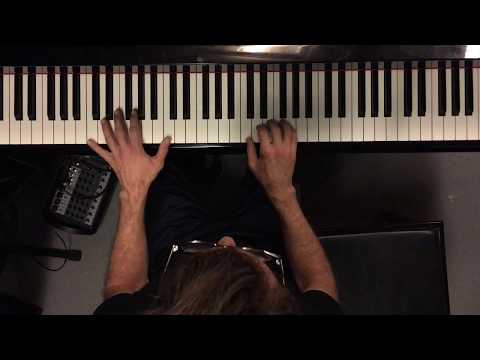
What is a triad? (Greg Spero, Weekly Piano)
- [00:24] 1-3-5 counted diatonically. "Diatonic means if you're in C it's all the white keys." Skip a step, take a note, skip a step, take a note.
- Major and minor demonstrated from the same root. One note moves, and the whole affect changes.
- [01:17] The function, which is the reason for the lesson: "it's the basic building block of Harmony that lets you know what your key Center is."
- He closes with the G triad going to the C triad, planting V-I before naming it. You met that already in A5.
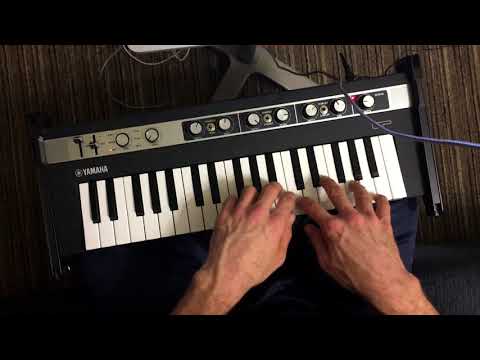
Inversions
- The trick that makes this easy: play the triad, play the same triad an octave above, then slide a three-note window up the stack. Every grouping of three consecutive notes is one inversion [00:43], [00:55].
- Three positions means two inversions, because the third grouping is the root position again an octave up. Chord tones never change: "same exact chord tones" [01:42].
- Greg is upfront that he skips the vocabulary here, at [01:14]: "I'm terrible with vocabulary." He tells you to look the names up. They are below, in At the piano. The mechanics matter more than the labels, but you need the labels to read a score.
- At [06:54] he says that soloing over F minor 7 he would not just play the plain chord, and at [07:15] he plays an inverted F minor 9 instead. That is the destination. A7 and A11 get you there.
Ear training: recognizing triads
- [00:46] Use it correctly: "you should just be listening to this don't watch me because you'll obviously see it but this is ear training." Turn the screen away.
- A dozen or so items, major and minor, with the answer spoken a beat after each chord. Say yours first.
- One item mid-drill is inverted, and at [01:34] he flags it: "it is a certain type of Triad but it is not based on the one of the Triad it's rooted in the three." Expect that.
- [02:24] His pass mark, and he means it: "get it 100% right if you can your ear will get you will will be a lot better."
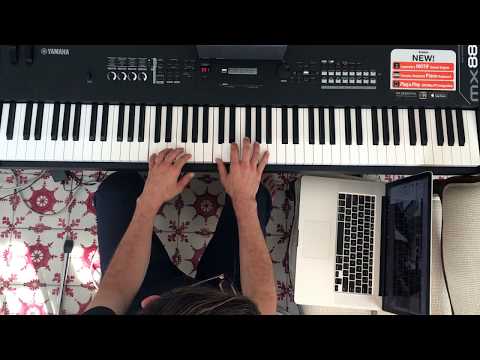
Basic Piano Lesson #1: Major scales and triads
- the on-demand triad standard, at [34:36], and the voice-leading demo at [48:28] that shows what triads are for
At the piano
The four qualities, built from the bottom third up:
| Quality | Formula | Thirds, bottom to top |
|---|---|---|
| Major | 1, 3, 5 | major then minor |
| Minor | 1, ♭3, 5 | minor then major |
| Diminished | 1, ♭3, ♭5 | minor then minor |
| Augmented | 1, 3, ♯5 | major then major |
Learn them as third-orders, not as alterations of major. The order of the two thirds is the identity of the chord, and that same idea scales directly to seventh chords in A7.
The inversions and their names. Root position puts 1 on the bottom, and its figured-bass shorthand is 5/3. First inversion puts the 3 on the bottom, spelled 3-5-1, figured 6/3, usually written just 6. Second inversion puts the 5 on the bottom, spelled 5-1-3, figured 6/4. The numbers count intervals above the bass note, which is why they change when the bass changes.
Which one to use. Root position is stable and heavy. First inversion is light and mobile, and it is the one that keeps a bass line moving by step. Second inversion is unstable on its own and wants to resolve, which is why it usually shows up passing through or at a cadence. In practice you choose the inversion that moves the fewest notes from the previous chord. That is voice-leading, and Greg demonstrates the principle from [48:28] of Basic Piano Lesson #1, moving C major to C minor to D7 to G7♭9. At [49:13] he gets from C minor to D7 "with barely moving at all on the keyboard," which is his definition: "each of these four voices is leading to the closest note."
Hands. Everything here goes in both hands separately before it goes in either hand fast. For most composers who also play, the left hand is the constraint. Triads are the cheapest way to fix that, because the shape is small and the ear checks the result.
Exercises
1. Triads on call
Do. Have a partner or a random generator name a root and quality. Play it in root position within two seconds, right hand, then left hand. Twenty-four calls per session covering all four qualities.
Done when: Twenty-four out of twenty-four land in under two seconds in both hands, at Greg's stated standard from Basic Piano Lesson #1 [34:36], where he asks for any major triad "just like at the drop of a hat" [35:07].
2. The diatonic triad ladder
Do. In C, build a triad on each of the seven degrees using only white keys, and say the quality out loud before playing it. Then do it in F, in B♭, and around the circle in the A8 order.
Done when: You can recite the seven qualities in order (major, minor, minor, major, major, minor, diminished) in any key without touching the keys.
3. The stacked-octave window
Do. Play a triad, play it again an octave up, then read off all three positions by sliding a three-note window up the stack. Major and minor, all twelve roots, both hands. Name the position aloud each time.
Done when: Any inversion of any triad appears instantly, without counting from the root.
4. Nearest-note chaining
Do. Play C major, then F major, then G major, then C major again, choosing each inversion so the fewest possible notes move. Write down which inversion you used for each. Repeat starting from a first-inversion C, and then a second-inversion C. Then move the whole exercise to three other keys.
Done when: The top voice never jumps more than a third across the whole chain, in all three starting positions, in four keys.
5. The ear drill, scored
Do. Run Ear training: recognizing triads with the screen turned away, writing your answer for every item before Greg says his. Score it. Then repeat with a partner adding diminished and augmented items, which the video does not cover.
Done when: 100 percent on two consecutive passes of the video, and 90 percent on a four-quality drill.
6. Bass-note dictation
Do. Play the Bach C major Prelude slowly and, for each bar, name the bass note and the triad it belongs to. Then do the same by ear with "Everything In Its Right Place," writing only the bottom note of each chord.
Done when: A full page of the Prelude is labeled correctly, and you can hear whether a chord in a recording is sitting on its root or not.
Checkpoint
- Any of the four triad qualities, any root, played within two seconds in either hand.
- All three positions of any triad, named and played on demand.
- Seven diatonic triad qualities recited in order in four keys, away from the piano.
- 100 percent twice on the triad ear-training video.
- One page of Bach labeled with bass notes and chords.
Read
- Source course, Lesson 11, "Harmony as a Living System." Read the opening pages now, before the seventh chords arrive. The claim that matters: "A chord is not a thing. It is a moment in a process." Learning triads as flashcards is fine as a drill and useless as an idea, and Lesson 11 is the antidote.
- Source course, Lesson 2, on the minor third as "the defining interval of the minor mode" and the major third as "brightness, stability, affirmation." One note moves between the two triads, and this is the paragraph that explains why that one note carries so much.