The idea
Greg told you the problem in the first lesson. "You had a lot of consistency in the thing that you played me before, but there was not really movement in it." And the fix, in the same breath: "you want to build to the place where a section happens naturally, rather than just have a thing and repeat it to be a section."
This lesson is the technical answer to that. A process is a rule you set in motion that generates both the note-to-note detail and the overall form at the same time. You do not decide where section two starts. The process decides, and your job is to choose a process whose arrival you can live with.
The source course frames the same idea from the other side: "form is not a container into which music is poured. Form is something that emerges from the musical materials themselves" (Source course, Lesson 24).
Watch
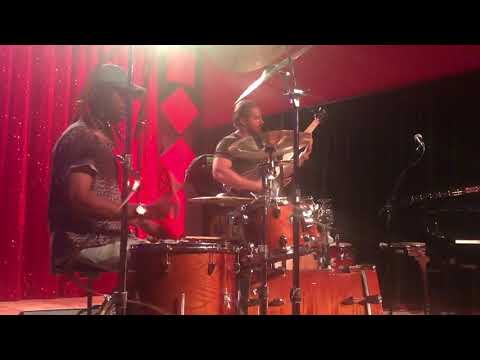
Polyrhythmic 17/16 groove
- Performance only. No transcript exists, so no claim about spoken content is made here.
- Count in sixteenths. The cycle is one sixteenth longer than four bars of four, so it sounds like a groove you know that keeps sliding off.
- Mark by ear where the left hand's cycle re-aligns with the downbeat you hear. That distance is the process's period, and it is your transcription assignment before the next lesson.

Advanced Pianists Need This!!!
- The structure, stated at [00:24]–[01:00]: over an eight-bar cycle, two arbitrary notes in bars 1–2, a response in bars 3–4, a call in bars 5–6, and a response in bars 7–8 that must use the same two notes you opened with.
- The pass criterion is absolute and he applies it to himself on camera at [02:57] when he misses it. "It doesn't really matter what you play in between as long as you repeat those same notes" [03:14]–[03:21].
- At [04:22] he restarts from a deliberately dissonant pair to prove the point: "it depends on something different. It's how you use the material that you're playing, no matter what the material is" [04:38]–[05:00].
- This is a process. You load it, and the last two bars are no longer your decision.

For Musicians - Improve Your Time
- Metronome at a deliberately odd tempo, 104, then 73, kept non-round so you never calibrate to a single number.
- Sound only beat one, clasp your fingers on it, feel every quarter internally.
- Do this before every process exercise below. A gradual process is audible only if the clock under it is honest.
Listen
Reich, Piano Phase (1967). Two pianos, or piano and tape. A twelve-note pattern on five pitches, E, F-sharp, B, C-sharp, D, across thirty-two measures in three sections. Both players lock in unison, one holds tempo while the other accelerates until it is one note ahead, they lock again, and repeat. In part one that cycle runs twelve times before returning to unison. Pass one, follow one player. Pass two, follow the resultant, the pattern neither player is playing. Pass five, mark each new lock and check whether you predicted it.
Animal Collective, "Banshee Beat" (2005). Osborn's reading, with his own timings: two chords, a clave-like sixteenth-note groove in a three-plus-three-plus-two shape, a second chord that takes over two minutes to arrive because the tonic pedal is extended that far, a groove that is built additively and is not fully formed until 2:59, and the "howling" vocal motive first appearing at 4:27. He calls it a structural crescendo and reads it as a non-recapitulatory version of Spicer's cumulative form.
Sleepy Eyes of Death, "Mean Time 'Till Failure" (2007). The mirror case in the same article. One F major to A minor two-chord motive developed by amplitude, timbre and texture only. The build levels off at 1:07 and a structural decrescendo runs from 2:12 to the end. No contrasting theme appears. Ask whether your own writing has ever survived that constraint.
King Crimson, "Discipline" (1981). Medeiros establishes the phasing analytically and specifies the mechanism precisely: the misalignment is produced by subtraction, the Clapping Music method, with one part shortened from a five grouped three-plus-two to a four grouped three-plus-one. It is not tempo divergence, which is the Piano Phase method. Two corrections you should carry: Tamm records Fripp denying direct Reich influence, so do not cite a lineage, and the circulating time-signature tables for the album are transcription-based fan sources.
Stravinsky, Variations (1964). Five minutes, full orchestra, three sittings, and the discipline of leaving things out. The source course's line: "every note must justify its existence. Every silence must earn its duration."
Radiohead, "2+2=5" (2003), first two and a half minutes. Osborn classifies it as multi-part polythematic and locates the section-group split at 1:54, on "a colossal shift in volume, texture, and timbre." That is a formal boundary declared by production rather than harmony. Check the timestamp yourself.
The comparison
The exact parallel. Babbitt's all-partition array and Reich's phase process are the same compositional gamble. Both set up an exhaustive procedure and let it run to completion. The source course describes Babbitt's form as "a path through a combinatorial space" where "the music continues until the array is complete," and says the result "has direction without having a destination" (Lesson 24). Reich's own words for his own version: "once the process is set up and loaded, it runs by itself." Both composers therefore hand the form to the procedure and keep only the surface.
Where it breaks. Audibility, and it is the whole difference. The source course is blunt that nobody hears Babbitt's array: "the structure is too complex, too abstract, to be perceived directly." Reich forbids exactly that. His doctrine is stated as a prohibition against "hidden structural devices," and his stated aim is that "I want to be able to hear the process happening throughout the sounding music." One composer's process is a private engine driving an audible surface. The other composer's process is the audible surface, and there is nothing else.
Reich adds a second prohibition worth quoting to yourself while you work: "one can't improvise in a musical process, the concepts are mutually exclusive." That rules out most of what you currently do at the piano, which is the point of the exercises below.
The second parallel, and where it breaks. Spicer's accumulative form, "the technique of building up a groove gradually from its constituent parts," comes out of Burkholder's cumulative form in Ives, whose prototype Spicer names as the finale of Beethoven's Ninth, where fragments of the "Ode to Joy" appear long before the theme does. That lineage is Spicer's own citation. The break: Ives builds on borrowed tunes and Beethoven on thematic development, while Spicer's form is often purely textural and he ties it historically to multitrack recording. A studio can add a layer without a player deciding to, which changes what the accumulation means.
A third, from the metal literature. Hannan generalises McCandless's ABAC additive metrical process into a broader ABAC phrase schema, in which "the music rotates through static and variable parts, the beginning (a) is static because it is repeated exactly, while the ending is variable (b or c) because it changes." The classical counterpart is the parallel period with an expanded consequent. The break: in Haydn the variable tail changes harmonic goal, while in metal it changes metric cardinality, so the second ending is literally longer in beats and no cadence is implied.
What this lesson does not have sources for. Sigur Rós, Talk Talk and Swans belong in a lesson on accumulation by reputation. Nothing in the research dossiers documents any of them, so no claim about them is made here, and none should be made in class until it is researched. Treat that as an open gap rather than an omission.
At the piano
Phase by hand, slowly. Take Reich's five-pitch collection, E, F-sharp, B, C-sharp, D, and build a twelve-note pattern from it. Left hand holds it at 60. Right hand plays the same pattern and accelerates, over about thirty seconds, until it is exactly one note ahead, then locks. Do it at half speed for a week before judging yourself.
Phase by subtraction. The King Crimson method. Left hand plays a five-sixteenth group phrased three plus two, right hand the same material shortened to four sixteenths phrased three plus one. Let them run. The misalignment is engineered rather than gradual, so it snaps rather than slides, and you should hear that against the exercise above.
Accumulative build. Choose a groove with five components: bass note, chordal stab, inner-voice figure, high sustained tone, rhythmic articulation. Enter them one at a time, each after the previous has run eight bars. Sixteen bars of complete groove, then subtract in reverse order. Spicer's technique and its inverse in one exercise.
The 17/16 cycle. Learn Greg's ostinato from the video by ear and notate it. Play it against a click that sounds once per cycle, then against straight sixteenths, and notice which one makes the sliding audible.
Leaving things out. Take the last thing you wrote and delete forty percent of its notes without adding anything. Play the result. Stravinsky delivered ten minutes against a commission for fifteen to twenty, and a five-minute Variations for full orchestra. His maxim is worth taping to the music desk: "I cannot compose more than I can hear."
Exercises
1. The eight-bar return
Do. Run Greg's exercise from Advanced Pianists Need This!!! over a blues in D. Two arbitrary notes in bars 1–2, response in 3–4, call in 5–6, response in 7–8 using the same two notes. Three consecutive successful cycles, then three more starting from a deliberately dissonant pair.
Done when: six cycles land the closing two notes exactly, and you can say which of the six sounded intentional and why.
2. Gradual process, audible
Do. Write a two-minute piece for solo piano built on one process the listener can follow the whole way through. Write the rule at the top of the score in one sentence. No improvisation anywhere.
Done when: a listener who has never seen the score can describe your rule after one hearing, in their own words.
3. Hidden process, inaudible
Do. Write a second two-minute piece on a process nobody could hear, letting it determine the pitch content exhaustively while every register, dynamic and articulation choice stays free.
Done when: the same listener cannot describe the rule, and the score proves the rule was followed without exception.
4. Phase two ways
Do. Record thirty seconds of the accelerating phase exercise and thirty seconds of the subtraction exercise, at whatever tempo is honest.
Done when: you can play both back and state, in one sentence each, what the misalignment does to the ear differently in the two cases.
5. Accumulate and dissolve
Do. Build the five-component groove, one entrance every eight bars, hold for sixteen, then remove components in reverse order. Record it in one take.
Done when: the entrance of component four is the moment a listener says the piece started, and you did not tell them which one to listen for.
6. Terminal instead of returning, then cut
Do. Write a three-minute piece whose peak arrives in a new final section rather than a returning chorus, with nothing from before the last minute returning. Then cut exercise 5 to half its length by removing material only.
Done when: you can name what makes the final section a peak without saying "it is louder," and you can name the two bars of exercise 5 you were most reluctant to lose.
Compose
Write the module's process piece: four minutes, piano plus any one other layer you can record.
Constraints. Two processes generate the whole form, one audible and one hidden, both stated at the top of the score. No section begins because you decided it should; each arrival is a consequence of one process reaching a stated point. No recapitulation. Something is subtracted in the final ninety seconds, and the piece ends on less material than it had at its densest.
Then write half a page naming which process produced each boundary, with timings from your recording. A boundary whose cause you cannot name is a box, and it comes out.
Checkpoint
- Six successful cycles of the eight-bar return exercise, three from a dissonant starting pair.
- Thirty seconds each of accelerating phase and subtraction phase, and what differs.
- The 17/16 ostinato accurately for eight cycles against a once-per-cycle click.
- Both two-minute pieces, with the rule statements sealed until after the listening test.
- The four-minute piece with score, recording and timed boundary analysis.
- In two sentences, what Reich's process and Babbitt's array share and the one prohibition separating them.
- The artists in this area for whom this curriculum has no sources.
Read
- Source course, Lessons 24, 26 and 27 (/library/garnett-course.pdf). Lesson 24 for the three post-tonal answers to what holds a piece together, including the Calder mobile against the novel. Lessons 26 and 27 for late Stravinsky's compression.
- Reich, "Music as a Gradual Process" (1968), https://ccrma.stanford.edu/courses/220b-winter-2024/readings/Reich_Gradual-Process.pdf. Three free pages, and the most useful three in this module. Read the passage on "impersonal, unattended, psycho-acoustic by-products" twice.
- Spicer, "(Ac)cumulative Form in Pop-Rock Music," twentieth-century music 1/1 (2004), https://www.cambridge.org/core/journals/twentieth-century-music/article/abs/accumulative-form-in-poprock-music/37CF5D672DD0096EB81A30CE911372BC. His definitions of riff and groove are the working ones here. Only the opening pages were verified for this course, so treat interior analyses as unconfirmed until you read them.
- Osborn, MTO 17/3 (2011), https://mtosmt.org/issues/mto.11.17.3/mto.11.17.3.osborn.html. Free and complete. The four-type taxonomy, the Animal Collective and Sleepy Eyes readings, and Example 12, which reproduces an actual Pro Tools session as a formal diagram.
- Saltini, Intégral 7, https://theory.esm.rochester.edu/integral/wp-content/uploads/2019/06/INTEGRAL_7_saltini.pdf. Set theory applied to rhythm, with real beat-class vectors for Clapping Music. Read it after the phase exercises.
- Hannan, MTO 28/1 (2022), https://mtosmt.org/issues/mto.22.28.1/mto.22.28.1.hannan.html. The ABAC schema and the death-metal terminal climax, used again in the next lesson.