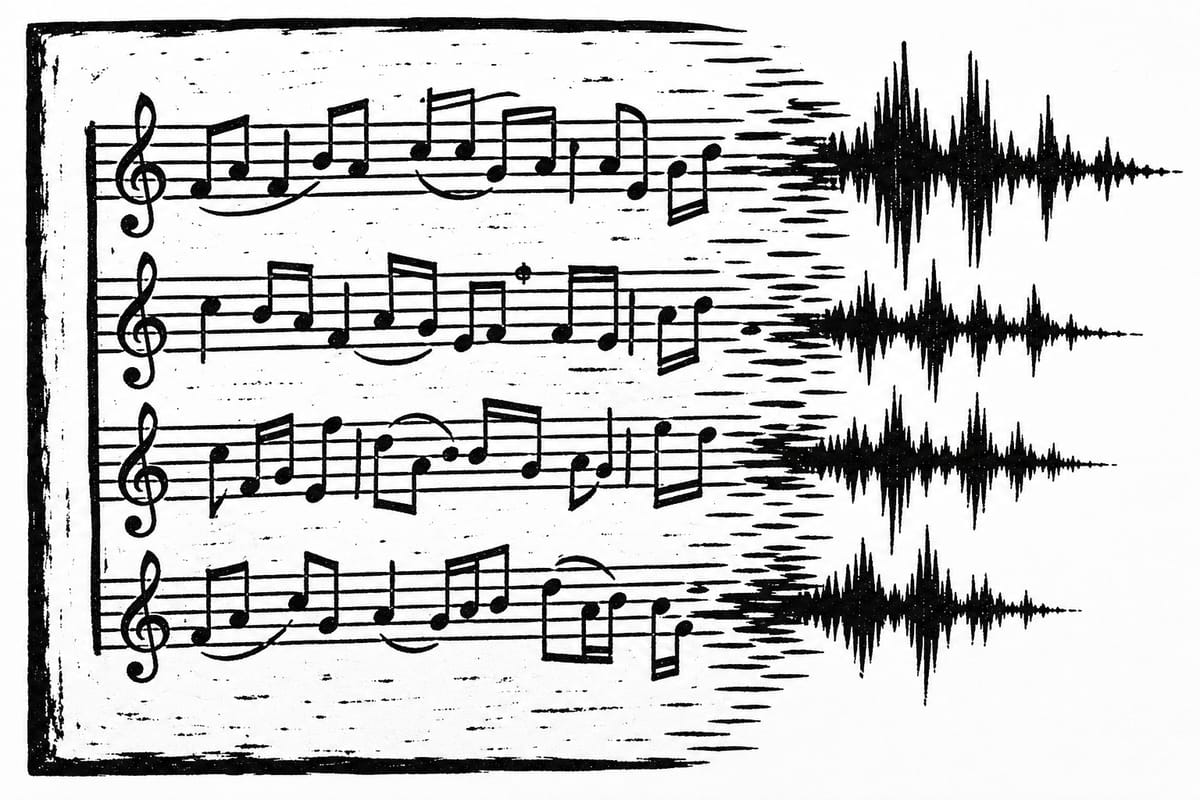
The idea
Two habits carry a composer for the rest of their life, and neither is a theory topic. The first is transcription, the only way to get another musician's decisions into your hands rather than into your notes. The second is Bach, which Greg keeps in the daily routine "for technicality, just to get an understanding of the key bed and where the notes are and how they sound with each other in different context."
You do not read yet, and that is fine here. Transcription runs entirely through the ear. Bach runs through the printed page, which is why A17 and A18 follow immediately.
Getting the notes is the beginning. Greg's line is that you could spend a lifetime on one line. The notes take an afternoon; the analysis, the transposition through twelve keys, and the feel take months, and that is where the composing comes from.
Watch
How To Transcribe a Piano Solo (the mechanics)
- Download the audio, drag it into the Transcribe app to get a waveform. Loud passages bulge, so you can see where the solo starts. Click a point, space bar starts and stops, and starting again resumes from where you clicked.
- Speed protocol: full speed if you can, otherwise 50%, then 60, 71, then plus 10% at a time to 100%. Back up a bar before each attempt.
- Single intervals: hear note one, hear note two, guess the interval, play your guess, compare, correct, move on.
- Chunking: four- or eight-bar phrases, learning the end of the chunk first and extending backward toward the beginning.
- The last layer is feel and it is the hardest. "You'll get it to 100% but the feel won't be great." 5 solos every pianist should transcribe
- Bill Evans, "Autumn Leaves," from about two minutes in, at the end of the bass solo. Chosen for motivic development and goal notes, which is A12 and A13 in someone else's hands.
- Oscar Peterson, "C Jam Blues," for feel and vocabulary, and one of his easier solos. Miles Davis, "So What," for telling a story with a small vocabulary. McCoy Tyner, "Passion Dance," for modal playing and quartal voicings, form first.
- Keith Jarrett, "The Way You Look Tonight," the hard one, solo starting around 1:04. Greg's method on it: write it on paper, circle the motivic development, draw lines through the progression. How to Transcribe and Study a Line on Piano (what to do afterward)
- The procedure, in order: transcribe, analyze, work out why it is a great line, pick one piece of it, learn it hands separately and in octaves and hands together, dissect the chords, flip each idea in time, then all twelve keys in half steps, then flip it harmonically and do all twelve again.
- Mark accents and velocity while you learn it, because the analysis uses them later. Pull the tune's chord chart and map every note to a chord tone or extension.
- Analysis methods he names: highest and lowest note as focal points, half-step chains linking interior notes, the octave-displaced return, and interruption (breaking a stepwise descent with a distant note so the ear bounces between two implied lines).
- Copy his caveat: "these are not things that he's thinking of consciously when he's playing it, I'm sure, but they are intuitive reasons that it sounds great." Tigran Hamasyan Transcription, the full hour if you can stand it. Watch him be wrong, correct his own terminology, and land on a conclusion. [17:00] is the point of the video: "this process of like figuring something out and thinking something is one way and messing with it and thinking it's another way and then coming to your conclusion in the end is what you should be doing." Why Every Jazz Pianist Should Learn Bach. [00:09] the G minor Gigue, [00:30] the C minor Minuet, [00:46] the A minor Prelude, the three he keeps around. [01:31] the reason: keyboard geography and touch. Learn Bach's Prelude in C Major (your piece)
- [02:32] Reduce each arpeggiated bar to one chord: C, then D minor 7 over C, then G7 over B. Check it against the score. Bar 1 is C, E, G, C, E; bar 2 is C, D, F, A, D; bar 3 is B, D, F, G, D. [03:13] "they're all moving as little as possible to get to the next chord." Between bars 2 and 3 the bass falls a half step, C to B, the D and the F hold, and the A steps down to G. Nothing leaps.
- [06:01] Tracing the top voice through the opening bars, E, F, F, E, "that's the up and then exactly the opposite back down," a symmetrical pattern.
- [08:03] Bar 8, the first hinge. The top voice reaches C for the first time (bars 1 to 7 top out on E, F, F, E, A, D, G), and at that same moment the bass is sitting on B rather than C. Bar 9 resolves it to A minor 7, A, C, E, G. [18:56] the same device recurs transposed: bar 16 is an F major 7 over E, and bar 17 resolves to D minor 7.
- [09:28] "what it should feel like is like you're not playing anything." [24:34] The false ending. Bach "tells you I'm ending, I'm ending, I'm ending, I'm not ending," because at bar 32 the chord over the C pedal becomes C, E, G, B♭, a C dominant seventh, which goes to F in bar 33. Learn to play Bach in 1 Hour
- The tempo ladder he runs: 62, 70, 80, 93, 101 and upward. The spoken "so that was at 180" at [06:49] is inconsistent with that ladder and should be treated as a slip.
- [01:19] "positioning the center of the weight of my arm over each individual note," every note, every time. [05:24] "I'm also getting rid of the music now," partway up the ladder. [09:45] For harder material, start below 60, sometimes at 40, giving each eighth note a full click. How to Learn Classical Music
- [01:53] The core drill, from Lawrence Hobgood: wrist over the center of the key, drop with a slight arm drop, lift, reposition, drop. [02:07] Take the fingering from the edition. [04:01] Repeat the line even when you played it correctly.
- [12:31] Why tension in Bach injures you specifically: four voices in two hands, all counterpoint, no rests for the hand. That is why the Prelude is a technique assignment as much as a repertoire one. Improv on Everything In It's Right Place and Improv #46 - for Schoenberg lovers are performances with no spoken instruction. Watch each for one question: in the Radiohead vamp, what supplies motion when the harmony supplies none; in the Schoenberg improv, what holds it together with no tonal center.
How To Transcribe a Piano Solo
- the mechanics: the app, the waveform, the speed ladder, working backward through a phrase
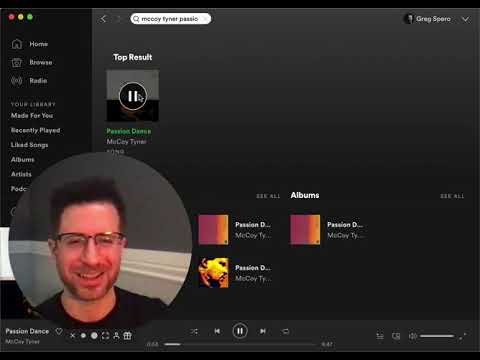
5 solos every pianist should transcribe
- which solos, in which order, and the specific quality each one is chosen to teach
How to Transcribe and Study a Line on Piano
- what to do with a line after you have it: the full analysis and transposition procedure
Tigran Hamasyan Transcription
- an unedited hour of the process going wrong and getting fixed; the honest version
Why Every Jazz Pianist Should Learn Bach
- why Bach is in the daily routine at all: keyboard geography, not repertoire
Learn Bach's Prelude in C Major
- the piece you are memorizing, analyzed chord by chord for voice-leading
Learn to play Bach in 1 Hour
- the metronome ladder as a whole learning method, demonstrated in real time
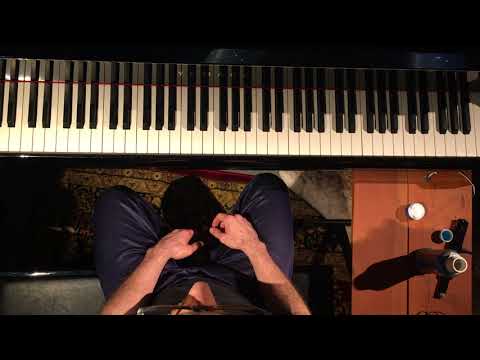
How to Learn Classical Music
- the wrist-over-the-key drop technique, and why tension in Bach injures you
Improv on Everything In It's Right Place
- listening target: development over a static harmonic bed; performance only, no spoken instruction
Weekly Piano Improv #46 - for Schoenberg lovers
- listening target: coherence from motive and contour with no tonal center; performance only, no spoken instruction
Listen
Run the source course's five-pass protocol on the Bill Evans "Autumn Leaves" solo before you transcribe a note of it.
- Linear: follow the right hand only. Where it rises, rests, repeats.
- Vertical: ignore the line, listen to the left hand and the bass, and the harmonic color under each phrase.
- Proximity: listen to the joins. Where he moves by step and where by leap.
- Distance: listen for material returning. Does a phrase from the first chorus come back changed.
- Integrated: hold all four at once. You will not manage it. Write a paragraph on what you heard in each pass that you had not noticed before.
Do the same five passes on BWV 846 across two recordings, one Gould and one Schiff. The notes are identical, so everything you hear differently is the thing you are studying.
At the piano
The Bach. Print an urtext edition of BWV 846 and use its fingering. Set the metronome so one eighth note gets a quarter-note click, at 40 to 50 bpm. Play one bar. Wrist over the key, drop from the arm, lift, reposition. Stop and check that the forearm and shoulder are slack. Repeat the bar even when it was correct.
Work in single bars for the first week. The piece is a chord progression in arpeggios, so learn the block-chord reduction alongside them; the reduction is what you will remember when the fingers forget. Bars 1 through 9 first, ending on the A minor 7, then 10 through 19, then to the end of the thirty-five. Raise the tempo by about 8 bpm only after a clean run, and take the score away three rungs before your target.
The transcription. Take Oscar Peterson's "C Jam Blues" if you want feel and vocabulary, or Bill Evans on "Autumn Leaves" if you want the motivic development A12 and A13 just taught you. Pick one.
Load it into Transcribe, mark the start of the solo on the waveform, name the key. Work in four-bar chunks, back to front, at 50% until the chunk is yours, then ladder up. Keep a written log of which chunk you are on so a bad day resumes instead of restarting.
Exercises
1. The transcription, notes
Do. Transcribe one full chorus of your chosen solo by ear, in four-bar chunks, learning the end of each chunk first. Ladder each chunk 50, 60, 71, 80, 90, 100%. Do not write anything down yet; hold it in your hands.
Done when: you can play the full chorus at 100% along with the recording, without the score, twice in a row.
2. The transcription, feel
Do. Record yourself playing the chorus against the recording. Listen back and compare your placement to the original, phrase by phrase. Adjust and re-record.
Done when: your phrasing sits where the record's does, not just your notes.
3. The transcription, analysis
Do. Pull up a chord chart for the tune. Map every note of one eight-bar phrase to a chord tone, extension, or non-chord tone. Mark the highest and lowest notes. Trace any half-step chains linking interior notes. Mark where the phrase starts against the bar, which may not be where it sounds like it starts.
Done when: you can name the function of every note in that phrase and defend where the phrase begins.
4. One line, all keys
Do. Take your favorite two bars out of the solo. Learn it hands separately, in octaves, then hands together. Play it in retrograde. Then transpose the original and the retrograde upward in half steps through all twelve keys, one key per day.
Done when: you can play those two bars, forwards and backwards, in any key called out, hands together, with a relaxed hand.
5. Bach, BWV 846, memorized
Do. Learn the Prelude bar by bar on the metronome ladder, wrist over the key, weight from the arm. Take the score away three rungs before target tempo. Alongside it, write out the block-chord reduction of the first eight bars with slash bass, and mark with arrows which voice moves between each pair of chords and by how much.
Done when: you can play the Prelude from memory, evenly, with the hand demonstrably slack at any point you stop, and you can play and name the eight-bar reduction.
6. Two voices, heard apart
Do. Listen to Two-Part Invention No. 1 in C, BWV 772, five times: upper voice only, humming along; lower voice only, humming along; then both. Then play the first eight bars right hand alone, left hand alone, then together as slowly as needed. If you cannot manage both hands, play one and sing the other. Identify the opening motive and trace it into the lower voice.
Done when: you can hum either voice on demand while the recording plays, and play the first eight bars hands together slowly with both lines audible as lines.
Checkpoint
This is the gate. Part B opens here.
- One full transcribed chorus, played at tempo, from memory, with the record's feel.
- A written analysis of eight bars of it, every note accounted for.
- Two bars of it playable in all twelve keys, forwards and in retrograde.
- BWV 846 played from memory, evenly, no tension.
- The eight-bar block-chord reduction of BWV 846 played and named.
- Both voices of BWV 772 hummable separately, first eight bars playable hands together.
Read
- Source course, Lesson 1. The five-pass protocol, and the claim that transcription already trains all four dimensions. The course's aim is to name what you are doing so you can do it on purpose.
- Source course, Lesson 4. Polyphonic hearing, the progression through the Inventions and Sinfonias into the fugues, and Exercise 4.1, which is Exercise 6 above. A chord is a momentary alignment of moving voices.
- A caution about the source course on Bach. Lesson 4 lists the C minor Fugue, BWV 847, as an entry point. Check its subject against the score rather than the course's prose. The kern corpus gives a continuous figure, C, B natural, C, G, A flat, C, B natural, C, D, with an eighth rest before it and no rest inside it. The course's description of a rising half step leaping up a minor third to E flat is the tonal answer at bar 3, not the subject. Three voices enter at bars 1, 3 and 7, so there is no stretto, and the fugue is 31 bars, closing on a tonic pedal held from the second half of bar 29 to the end.
- The scores. BWV 846 and the Inventions as urtext editions, or free public-domain scans from IMSLP. You want printed fingering.