The idea
You already know how to vary a theme by changing its notes. This lesson takes the notes away from you.
Stravinsky's Variations has no theme. What varies is the medium. The source course states the principle in one sentence: "to vary something, you do not need to change its notes. You need to change how those notes enter the world" (Source course, Lesson 27). The same serial material appears three times, first as twelve solo violins, then as ten violas with two double basses, then as twelve winds. The counterpoint is identical. The music is not.
For a producer this is not an exotic idea. It is your day job with a theory attached. What is new is the claim that the timbral choice can carry the form, which means the moment a section changes can be a moment nothing changes except the sound.
Watch
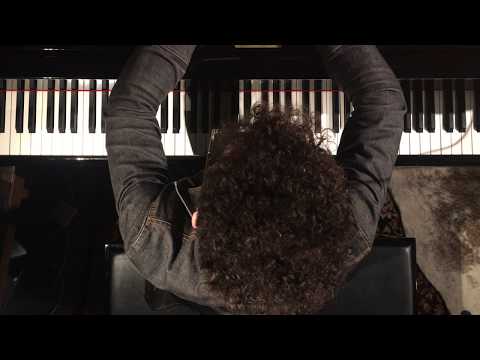
Colors and Superimpositions on the Piano
- Superimposition named at [03:39]. A triad in the right hand over a fixed root, moved around the circle of fifths, is the control for brightness and darkness.
- The brightness ladder at [17:43]. Over a fixed C root, moving the upper triad up the circle gives G, D, A, E, B, F-sharp, each brighter; down the circle gives F, B-flat, E-flat, A-flat, D-flat, G-flat, each darker.
- Why it closes on itself, at [21:53] and [55:41]. "You end up in the same place at the other side in complete dissonance." Brightness is relative, and the two directions meet.
- Managing dissonance by thinning the bass at [18:43] and [20:51]. Voice the left hand 1-5-9 rather than adding the third, "so you have more space to do superimpositions that will not be too dissonant." That is a spacing decision doing harmonic work.
- The assigned exercise, written on camera at [01:00:59]: one key per day, run all the colors, improvise over each, and keep the same top note through the sequence so a melody emerges.
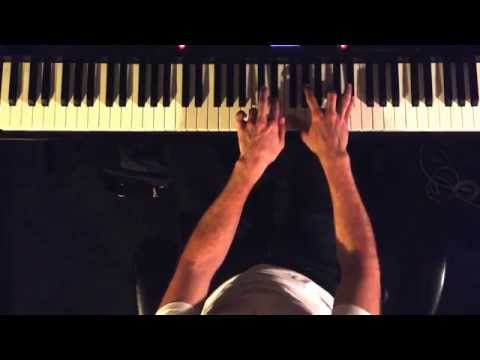
Block Chords and Parallel Motion
- Block chords defined at [00:38]: melody note on top, chord tones filled underneath, the whole structure moving in parallel.
- Doubling as orchestration at [05:27]. "You can double the extensions in octaves when you're doing block chords like this." Same pitches, different object.
- Tenths at [05:47], and the inner-voice melody at [08:20], which is register used to change what a listener attends to.
- The Bill Evans hand split at [10:42]: right hand on the downbeat, left hand on the swing.
Listen
Stravinsky, Variations (1964). Five minutes, three sittings. First pass, register only the three colors: the high shimmer of twelve violins, the dark warmth of violas and basses, the fractured brilliance of twelve winds. Second pass, hear the same pitch content through the three scorings, tracking intervals, gestures and contours that survive. Third pass, the episodes between the sections, and what their structural function is.
Stravinsky, Requiem Canticles (1966), Postlude. Four hearings minimum. A piercing chord in flutes, piano and harp, then silence, then a response in celesta, vibraphone and tubular bells. The pattern repeats three times, then three final chords of tolling bells alone. The source course's reading is the one to test: the sharp chords exist in clock time, brief and measurable, while the bell tones exist in acoustic time, their resonance extending past the notated duration and producing overtones never written into the score. Robert Craft named these the Five Chords of Death.
Stravinsky, Movements (1959). The whole thing, listening for the four interludes. They lack the piano, and that absence is the structural signal. The source course's principle: "the scoring is not something applied to pre-existing musical ideas. The scoring IS the musical idea." Each combination "is not merely a different color applied to the same music. It is different music."
Babbitt, Arie da Capo (1974). For one idea, from Lesson 25. A minor ninth low, cello and bass clarinet, is heavy and almost menacing. The same interval high, flute and violin, is bright and transparent. Register is a compositional dimension rather than a placement decision.
Mew, "Chinaberry Tree" (2005), from 2:05. Osborn's third section group is synth pad only, and it ends on a held chord whose "top partials shift like a kaleidoscope," which he likens to spectral composition. A whole formal section defined by timbre.
The Books, "Tokyo" (2003), around 1:26. Osborn's example of glitching as form. Samples of one to three seconds, edits left unsmoothed, and a cello line that is itself spliced tape snippets, with waveform evidence at that timestamp.
Radiohead, "2+2=5" (2003), 1:40 to 2:10. The section-group boundary Osborn locates at 1:54 is "a colossal shift in volume, texture, and timbre." In the book he adds that this is where distorted 4/4 power chords bring rock timbre onto the album for the first time (Osborn 2016, p. 99), so the boundary is doing work for the whole record. Listen to the thirty seconds around it and name what changed in harmony. Almost nothing did.
Greenwood, Popcorn Superhet Receiver (2005), Part 1, twice. First pass, do not track pitches. Track the state of the noise: solid wall, wall thinning, wall gone. Second pass, wait for m. 93, where every instrument lands on one unison F sharp and the wall collapses into a single note. Then play Penderecki's Threnody for the Victims of Hiroshima (1960) back to back with it and hear what Greenwood took and what he did not.
The comparison
The exact parallel. Stravinsky's Variations and a producer's arrangement decisions run the same operation. Hold the material constant, change the delivery, and the listener experiences a new event. The source course calls this variation of the medium, and Lesson 26 says why it works: each new instrumental combination "enters like a character walking onstage."
The best-documented modern counterpart is Hannan's death-metal terminal climax, from his 2022 article. He defines the closing section by its sound rather than its harmony: a break in texture, a cessation of vocals, moderate-to-slow tempo often after a tempo change, spacious let-ring triadic or modal chords, layered guitars and solos, gradual fade, repetitive structures. Every item is a timbral or textural specification, so the formal function is defined by scoring, which is Stravinsky's premise arrived at from the other end of the century.
Where it breaks, first break. Stravinsky's timbres are notated and transferable, and a different orchestra plays the same Variations. The djent equivalents are not transferable that way, and the literature says so. DePue's conclusion is that an accomplished rock guitarist's style is a personal integration of technique, sensibility and gear, so that "style" includes the signal chain. Sallings makes the same point from inside the notation problem: to analyse djent at all he had to write his own Transcription Preference Rules, covering key signature, density, tactus, time signature, snare and drum duration, because those choices silently determine what any later analysis can say. There is no neutral score of this music to hand to another band.
Where it breaks, second break. Stravinsky's timbral variation is a compositional argument about identity, whether material stays itself under transformation. Hannan's "difficulty as heaviness" argues that in metal the sonic result is doing something else: rhythmic difficulty enhances perceived heaviness through "enactments of sonic metaphors for size, weight, density, power, transgression and seriousness." That is affect production rather than identity testing. Both use sound structurally, and they are pointed at different questions.
Where the composer disclaims the theory. Misha Mansoor says of his own harmony, "I do not know a thing about music theory, unfortunately, so I have no idea what these chords are called." He describes writing to a steady pulse and landing in four by default, and on "Buttersnips" a pattern of five played against that pulse so that it "dances around it." All of that is interview-based, and any lesson presenting djent harmony as theoretically derived misrepresents the composer's process.
The same premise, built out of noise. Jonny Greenwood's Popcorn Superhet Receiver (2005) runs Stravinsky's move backwards. Stravinsky holds the pitches and changes the scoring. Greenwood starts from the sound and lets pitch arrive last. His own account, from the score's liner notes: "I understood that two octaves of quarter-tones would produce white noise, and wanted to start from there, treating it like a big block to carve up and distort." Saturate, then remove. What carries the form is the state of that noise wall. Prostran's map of Part 1, made from the Faber score, has sustained notes turning into falling ones through m. 29, the microtonal wall arriving at m. 30, every instrument collapsing onto one unison F sharp at m. 93, the wall returning at m. 106, and from m. 118 opposite pairs of strings filling each other's negative space with opposed dynamics and rhythmic placement. The close, mm. 181 to 206, staggers a microtonal ascent between individual players to manufacture a Shepard tone. Every formal event in that list is a timbral event.
Two more things from the same piece. In Part 2b the strings strum with guitar plectrums, and Prostran shows that Greenwood's notation for those muted strums is standard hi-hat notation moved down a sixth onto the centre staff line. A drum-kit part inside a string score, and it came out of a failure. The players had tried to reproduce an electronic drum machine and, in Greenwood's words, "it didn't work at all." Second, the Penderecki connection is the composer's own. He wanted "large, Penderecki-style microtonal clusters," and the 2012 Nonesuch recording puts Threnody for the Victims of Hiroshima (1960) beside Popcorn under Penderecki's own baton. Two limits. The only scholarly analysis of Greenwood's concert works is one MA thesis, so name Prostran and never say "scholars agree." And Penderecki's clusters are an elegy made of extended techniques, while Greenwood's begin as radio static and get carved, which is studio thinking wearing an orchestra.
What this lesson still does not have sources for, stated plainly.
- A timbre chapter in Osborn's Radiohead book. The book itself is verified, and it is Everything in its Right Place (Oxford, 2016, not 2017). One page-numbered timbre claim from it is used above, at p. 99. No timbre chapter is documented, so any other page reference to it is to verify.
- Prepared piano and extended technique as a named historical practice. The exercises below work on any piano you own, and none carries a historical attribution, because the source material digested for this module makes no claim about that repertoire.
At the piano
The brightness ladder, played as orchestration. Fix a C root voiced 1-5-9 in the left hand. Run the upper triad up the circle, G, D, A, E, B, F-sharp, improvising over each, then down, F, B-flat, E-flat, A-flat, D-flat, G-flat. Keep the same top note throughout so a melody appears across the twelve colors. Greg's own assignment, and the piano's version of changing the scoring without changing the counterpoint.
One passage, three registers. Take eight bars of your own music. Play it as written, then an octave and a half higher with nothing else changed, then two octaves lower. Record all three. Babbitt's minor-ninth observation predicts three different pieces. Check whether you get them.
Spacing as substance. Take a four-note voicing. Play it closed inside one octave, then open across two, then across three with the same four pitch classes, then with the extensions doubled in octaves per the Block Chords video at [05:27]. Four objects, one chord.
Attack and decay. Play one chord four ways: released immediately, held with the fingers, pedal caught after the attack, pedal already down. The fourth includes the sympathetic ringing of every undamped string. That is the piano's acoustic halo, and the Requiem Canticles Postlude is the model for using it structurally.
The wall, carved. Lay both forearms across the keys from the bottom of the instrument up to middle C, pedal down, and hold. That is your noise. Now take it apart. Lift one arm, then all but four fingers, then all but two, choosing which pitches survive each cut. Greenwood's premise on a piano you own. Quarter tones are not available to you, so density and register are the variables instead of tuning.
Silence with resonance in it. Play a loud low cluster with the pedal down, lift your hands, and let it decay ten full seconds before the next event. Time it. Most people cannot hold five.
Exercises
1. Same notes, three worlds
Do. Write sixteen bars for piano. Then produce three versions that differ only in register, spacing and articulation, with every pitch class in the same order in all three. Record all three at the same tempo.
Done when: a listener hears three pieces, and you can prove from the scores that the pitch content is identical.
2. The color ladder as a melody
Do. Run Greg's twelve-color sequence over a fixed C root with a single held top note, one key per day for a week.
Done when: you can name the mood change at every step, arrive at the far side from both directions, and say why the two directions meet.
3. The timbral boundary
Do. Write a two-minute piece with exactly one formal boundary, and mark that boundary using only volume, texture and register. Harmony and rhythm must continue unbroken across it.
Done when: three listeners independently place the boundary within two seconds of where you placed it.
4. Terminal climax, built to specification
Do. Write a closing section following Hannan's list: break in texture, no vocal, slower tempo after a change, spacious let-ring chords, layered lines, gradual fade, repetitive structure. Attach it to any earlier exercise.
Done when: you can point to each item on his list in your own score, and the section reads as an arrival rather than an ending.
5. Attack taxonomy
Do. Record one chord eight times, varying only attack, release and pedal, and label them.
Done when: you rank all eight by perceived weight and a listener reproduces your top three.
6. The acoustic halo, and the glitch
Do. Compose sixty seconds in which every event is followed by a decay you have timed and notated in seconds, and no new event begins before its predecessor's decay is over. Then, in Logic, cut a thirty-second passage of your own playing into samples of one to three seconds, reorder them, and leave every edit unsmoothed with no crossfades.
Done when: you can perform the sixty seconds with a stopwatch and never enter early, and the glitched version has audible seams and a shape you can describe in one sentence.
Compose
Write the closing piece of Module 7: five minutes, piano plus at least two other timbral layers you record yourself.
Constraints. One body of material stated three times, with identical pitch content in all three. Every difference is register, spacing, attack, layering or processing. At least one formal boundary is marked by timbre alone, with harmony continuing across it. The final ninety seconds follow Hannan's terminal-climax specification. Somewhere there is a decay of at least eight seconds that nothing interrupts.
Then write one page listing, per statement, what changed and what stayed. If the honest answer anywhere is "I also changed some notes," rewrite that statement.
Checkpoint
- The twelve-color ladder over a fixed root with a held top note, both directions, from memory.
- One passage in three registers, and what each register does to the same intervals.
- One chord in eight attack and pedal states, ranked by weight.
- The timbral-boundary piece, passing the three-listener test.
- The five-minute piece with score, recording and the one-page identity list.
- In two sentences, what Stravinsky's variation of the medium shares with a producer's arrangement pass and the one thing that does not transfer.
- One formal event in Popcorn Superhet Receiver Part 1, named with its measure, and the timbral change that produces it.
- The two claims still marked to verify, and why each is unverified.
Read
- Source course, Lesson 27 (/library/garnett-course.pdf). Variation of the medium, the twelve-part invention in three scorings, and the Postlude's two kinds of time. Read it after the second listening.
- Source course, Lesson 26 (/library/garnett-course.pdf). Orchestration as substance, the interludes as structural signal, and what Stravinsky took from Webern as against what stayed his own.
- Source course, Lesson 25 (/library/garnett-course.pdf). Register as a compositional dimension. Two paragraphs, and the most portable idea here.
- Osborn, MTO 17/3 (2011), https://mtosmt.org/issues/mto.11.17.3/mto.11.17.3.osborn.html. Free and complete. The Mew, Books and Radiohead readings quoted here, with his own timestamps.
- Osborn, Everything in its Right Place: Analyzing Radiohead (Oxford, 2016), https://doi.org/10.1093/acprof:oso/9780190629229.001.0001. One page for this lesson, p. 99, on the timbral seam in "2+2=5."
- Prostran, "Jonny Greenwood Scores the Western" (MA thesis, Dalhousie, 2017), https://dalspace.library.dal.ca/handle/10222/73268. Chapter 3 for the structural map of Popcorn Superhet Receiver, Figure 3.6 for the hi-hat notation. Read it as one person's careful work, not a field consensus. It misdates Penderecki's Threnody as 1994 in one sentence. The year is 1960.
- Hannan, MTO 28/1 (2022), https://mtosmt.org/issues/mto.22.28.1/mto.22.28.1.hannan.html. The terminal-climax specification you build to in exercise 4.
- Sallings (UNT, 2021), https://digital.library.unt.edu/ark:/67531/metadc1808378/. Read the Transcription Preference Rules chapter before you next argue about what a metal riff "is."
- DePue (UC Riverside, 2022), https://escholarship.org/uc/item/6qh4d3f0. For the argument that tone, technique and compositional voice form together. Historiography rather than analysis.