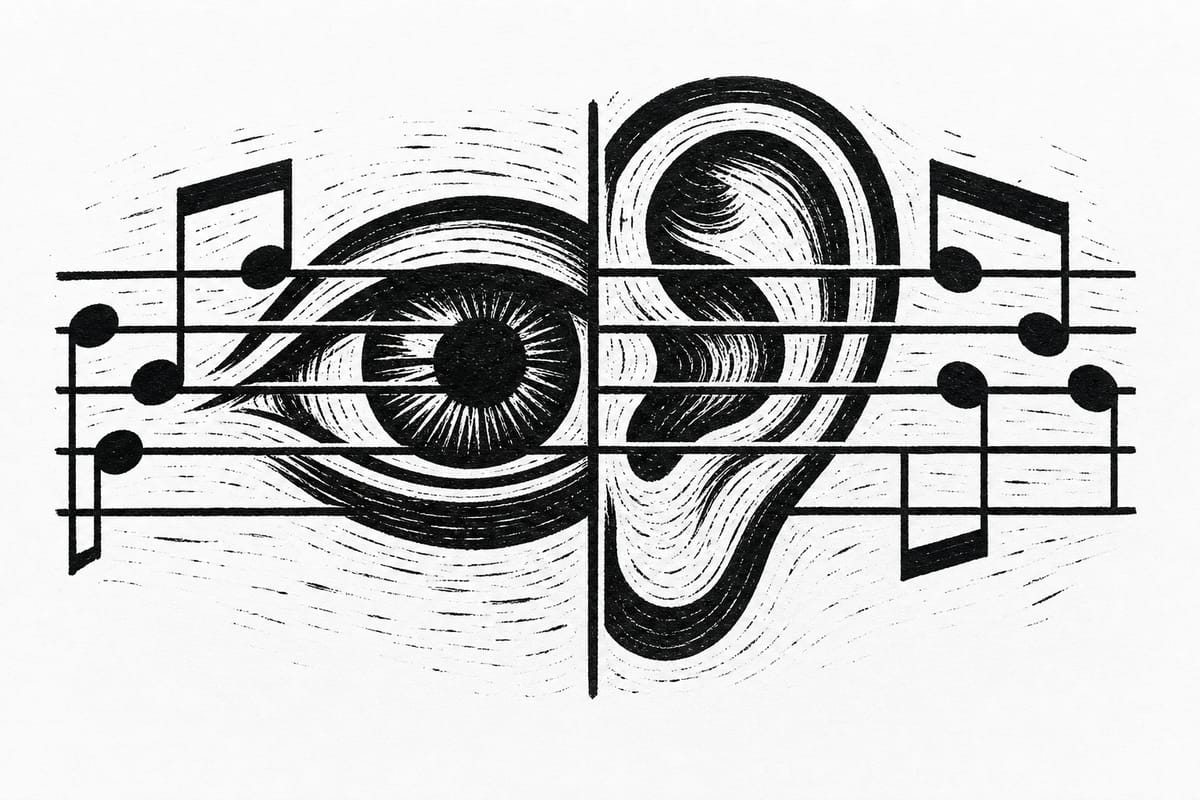
The idea
You said you have not read staff since high school, that you barely read bass clef, and that you learned tabs instead. That is the single largest gap between where you are and being able to write music down.
Reading and writing are one skill practiced two ways. Reading turns marks into sound. Writing turns sound into marks. The same internal map serves both, and the fastest way to build it is a small daily dose of reading plus a small daily dose of dictation, run for twelve weeks without exception.
Ten minutes a day, every day, rather than thirty minutes once on a Sunday. Five minutes daily beats thirty minutes weekly, and the material has to be easy enough that you get roughly 70 to 80% of it right on the first pass. If you are getting everything right, the material is too easy. If you are stopping, it is too hard.
One rule matters more than all the others. Do not stop. Play through the mistake, keep the pulse, keep your eyes ahead of your hands. Stopping to correct a note is practicing the thing that destroys sight-reading.
Watch
There is no Weekly Piano video on sight-reading. Greg says in Learn Bach's Prelude in C Major that he is a very bad sight reader, which is worth knowing, because this part of the curriculum is where you get to be better than Greg at one specific thing. The three videos below are here for reading habits embedded in other lessons.
How to Learn Classical Music
- [02:05] "You look at the fingering on the chart, because they'll generally give you the right fingering." He adds that a lot of study goes into what the fingerings should be, so take them from the page rather than redo that study yourself. Taking fingering from the page is a reading habit before it is a technique habit. It forces your eye to carry information your ear cannot supply.
- [04:01] Repeat the line even when you played it right. In sight-reading the equivalent is a second pass at the same tempo without correcting anything.
Learn to play Bach in 1 Hour
- [05:24] The sheet music comes away partway up the ladder. Reading is the on-ramp, and memory takes over. Do not confuse reading practice with learning a piece; they are separate activities with separate material.
- [09:48] Sometimes he starts below 60 bpm, at 40, playing quarter notes for the eighth notes in the piece, so every eighth gets a full click. That tempo choice is exactly right for chorale reading.
Learn Bach's Prelude in C Major
- [01:41] "Now mind you I'm a very bad sight reader." He says it before he starts, not as an excuse afterward.
- [16:32] He catches himself doubling notes he should not be doubling. Notice that it costs him time on camera. That is the concrete case for doing this work now.
At the piano
Set up three things before day one.
A stand and a stack. Buy Paul Harris Grade 1 and Grade 2, Kember Volume 1, and one rhythm book (Starer or Bellson and Breines). Get the Riemenschneider chorales; the Internet Archive scan at https://archive.org/details/bachriemenschnei0000bach is free and complete. Put them on the stand and leave them there.
A fixed slot. Ten minutes, same time every day, before your scales rather than after. Sight-reading done tired is sight-reading done badly.
A rule about the eyes. Look at the score, not at your hands. This is the reason a guitarist's transition to reading at the piano is hard. You are used to looking at the fretboard. Cover your hands with a book or a towel for the first two weeks if you cannot resist. Read at least one bar ahead of where you are playing.
Interval reading beats note-name reading. Read the shape, not the letters. A third looks like a third whether it is on lines or spaces, and the shape is what your hand executes. Note names are for talking about music, not for playing it.
Exercises
1. The daily ten minutes. Do: Run this every day without exception.
- Minutes 0 to 1, scan. Key signature, time signature, the hardest interval or rhythm on the page, the first two bars and the last two bars. Feel a steady pulse before you play a note.
- Minutes 1 to 6, one new page. One fresh page from Harris or Kember at your current grade, at a tempo where you will get 70 to 80% right. Play it straight through. Never stop, never go back.
- Minutes 6 to 8, one chorale phrase. One phrase of a Riemenschneider chorale, hands together, very slow, no tempo target at all. Four-voice reading is the point.
- Minutes 8 to 9, one rhythm drill. One exercise from Starer or Bellson and Breines, clapped or tapped, no pitches.
- Minutes 9 to 10, review, no replaying. Write one line in a log about the pattern that tripped you, not the individual note. Never repeat today's page tomorrow. Done when: you have run 60 consecutive days without a skipped session and without repeating a page.
2. Rhythm, separated from pitch
Do. Work through Hindemith's Elementary Training for Musicians Part 1, clapping and counting aloud, twice a week from week 1. Add Starer's simple exercises daily from week 3, and clapped Bellson and Breines syncopation three times a week from week 5. Use Teoria's free rhythmic reading drills (https://www.teoria.com/en/exercises/rr.php) on days you are away from the piano.
Done when: you can clap and count a syncopated 4/4 line at sight, first pass, without the pulse wobbling.
3. The chorale ladder. Do: Build up voice by voice through the twelve weeks.
- Weeks 3 and 4: soprano line only, single line, right hand.
- Weeks 5 and 6: soprano and bass, two voices, hands together, slow.
- Weeks 7 and 8: three voices.
- Weeks 9 onward: all four voices, hands together, very slow, no stopping, around 60 to 72 bpm. Done when: you can play a chorale you have never seen, four voices, hands together, at a slow steady tempo, without stopping.
4. Clef reading, away from the piano
Do. Ten minutes on Teoria's Grand Staff Reading (https://www.teoria.com/en/exercises/gs.php) and Clef Reading (https://www.teoria.com/en/exercises/clef.php) drills, daily in weeks 1 and 2, then twice a week. Both are free and work with a MIDI keyboard. If you want adaptive generated material later, Sight Reading Factory or Piano Marvel's SASR test both do that; neither is required.
Done when: bass clef reads as fast as treble clef, with no counting up from a landmark note.
5. Dictation: your own playing, onto paper
Do. From week 9, record yourself improvising for one minute. Pick eight bars of it. Write those eight bars down by hand, pitch and rhythm, from listening alone. Then check at the keyboard and mark every error. From week 11, do this daily.
Done when: an eight-bar phrase comes out correct in pitch and rhythm on the first written pass, verified against the recording.
6. Handwrite before you engrave
Do. Every motivic-development exercise from A12, A13, A13b and A14 gets written by hand on manuscript paper before it goes into Sibelius. Every one. No exceptions, including the ones you think are trivial.
Done when: your handwritten manuscript and the Sibelius engraving of the same idea agree, note for note and rhythm for rhythm, without you fixing the paper afterward.
Checkpoint
- 60 consecutive days of the ten-minute routine, logged, with no page repeated.
- Harris Grade 5 or 6 pages read at sight, straight through, no stopping.
- A previously unseen Riemenschneider chorale played hands together, four voices, slow and steady, without stopping.
- A syncopated rhythm line clapped and counted correctly at sight.
- An eight-bar melody written down correctly, pitch and rhythm, on the first pass, checked against the source afterward.
- A stack of handwritten manuscript pages covering every A12 to A14 exercise, matching their Sibelius versions.
Read
- Paul Harris, Improve Your Sight-Reading! Piano, graded workbooks, one grade at a time. The current New Edition was revised in 2008 for the ABRSM syllabus and is still what is sold. Start at Grade 1 even though your theory is well past it, because the grades measure reading rather than understanding.
- John Kember, Piano Sight-Reading, Vols. 1 to 3 (Schott). Run these in rotation with Harris so you are never reading two consecutive pages from the same author's habits. Vol. 1, Vol. 2, Vol. 3; Vol. 3 has 136 graduated exercises.
- Paul Hindemith, Elementary Training for Musicians. This is the dictation and rhythm-reading spine, and it is the book that connects reading to writing. Part 1 from week 1.
- Bach, 371 Harmonized Chorales, ed. Riemenschneider. Four-voice reading, and the best four-part writing model you will ever have on the stand. The free Internet Archive scan is complete.
- Robert Starer, Rhythmic Training and Bellson and Breines, Modern Reading Text in 4/4. Rhythm isolated from pitch. Starer goes further into complex and mixed meters, which feeds straight back into A15.
- Georges Dandelot, Manuel pratique pour l'étude des clés, optional, for clef work if you want a paper alternative to Teoria. Note: the "Bona" solfège method sometimes recommended alongside it could not be verified as a current, distinct, in-print title, so it is not cited here.
- The method sources, all short. The "Fundamentals of Piano Practice" sight-reading chapter for the play-through-mistakes rule, Topham for "whatever you do, don't stop," and the Sightreader piece for the research behind daily short doses and the 20 to 30% wrong difficulty target.