The idea
For most players the left hand cannot yet support the right: riff up top and you lose all ability to do anything down low. That is a technique problem and it is also a hearing problem, and this lesson works on the hearing half.
Source course, Lesson 4 explains why the hearing half is hard. Your brain picks the most prominent stream as the figure and pushes everything else into the ground. Polyphonic hearing is the deliberate override of that.
The course's payoff line is the one to carry: a chord is not a static object, it is a momentary alignment of moving voices. Once you hear that, harmony stops being a list of shapes you select from and becomes something you steer. The course puts it in six words for a jazz player: you stop selecting chords and start moving voices.
Expect the improvement to arrive in jumps. A passage that sounded like a blur will one day resolve into two distinct lines, and after that you cannot unhear it.
Watch
Voiceleading exercise
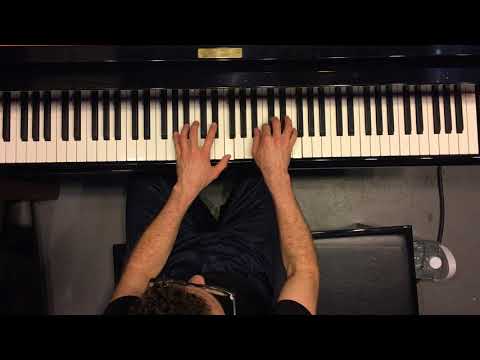
- Greg is learning this one on camera, from Russell Ferrante. The structure at [00:39]: "these are all pattern exercises, so it's the same pattern over and over in a diatonic scale in a way that leads you through a circle of chords."
- The chain from [00:20]: I on C, to IV, to V with the dominant 7, to iii minor over its 3, to vi minor, onward to minor ii.
- The assignment at [02:15]: all keys, moving up by half step. His addition at [02:46]: flip it upside down and play the mirrored version. He names the mirror axis inconsistently, so take the axis from his other reverse-harmony lesson.
- What to take here: the shape stays and the voices move. That is voice-leading heard from the inside.
Learning Bill Evans Solo Technique
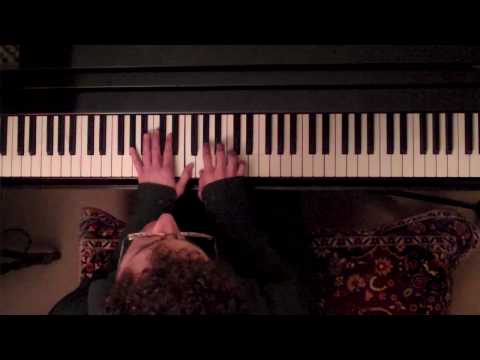
- The concept at [00:09], credited to Evans: pick one note and make it the goal point of every line. Why it works, at [00:38]: "it gives solos structure and it gives your lines structure and it gives it a form."
- The example is "Waltz for Debby" with C as the goal, the tune's first melody note. At [04:12] the A section modulates to A major, where C does not exist, so he takes C sharp.
- What that substitution expresses, at [04:27]: "it kind of sounds like you're trying to get back to your home base but you can't really. And then eventually, once the home base becomes part of the chord, then you can get back."
- The relevance here: a held goal note is a second voice, even when one hand is playing.
Tigran Hamasyan Transcription
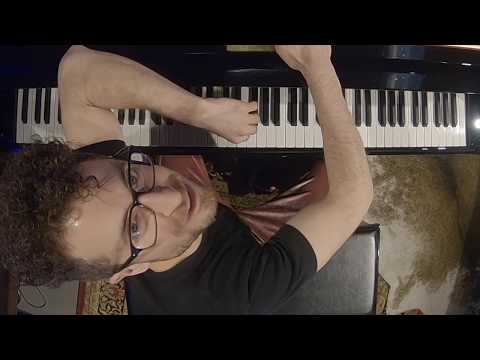
- Over an hour, unedited, one line. Watch to [20:00] this fortnight.
- The separation at [01:50] and [04:56]: the left hand is an ostinato he first calls 6/8 and then corrects to 12/8, and the right hand superimposes groupings of five.
- The arithmetic at [07:36]: three groups of five fill out the rest of the bar so the next phrase starts on beat one, a fifteen-beat phrase of twelve plus three.
- The real discovery at [15:48], reached by counting rather than theory: the phrase lengths grow and then shrink, landing on 5, 5, 5, 6, 7, 6, 5.
- The tempo discipline at [30:48]: he starts at 20 bpm.
Listen
Bach, Two-Part Invention No. 1 in C major, BWV 772. About one minute long, and Source course, Lesson 4 builds its whole Stage 1 on it. Listening 1: the upper voice only, humming along. Listening 2: the lower voice only. Listening 3: both.
Then the harder instruction: at the imitative entries, force yourself to switch. Follow the left hand's imitation and let the right hand recede. Repeat with Inventions 4, 8, and 13.
The course says why each is on the list. No. 4 in D minor has a clear subject and a chromatic countersubject easy to tell apart from it. No. 8 in F major has the hands trading material constantly, which trains you to follow a motive across registers. No. 13 in A minor has a driving lower voice, so start there if the lower voice keeps vanishing.
Bach, Sinfonia No. 9 in F minor, BWV 795. Three voices. Track the middle voice through the whole piece. The course's claim is strong and correct: hearing the middle voice is perhaps the single most valuable exercise in polyphonic listening, because the middle voices are where voice-leading craft shows.
Herbie Hancock, "The Eye of the Hurricane" (Maiden Voyage, 1965). A twelve-bar blues in F minor. Waters's analysis is the most measure-specific thing in this curriculum's jazz sources, and Hancock's stated aim, from a 1994 interview, was to displace the accents and avoid rhythmic cliché.
Listen for two passages. At mm. 55–57, a pattern repeating every three beats stratifies 3/4 over 4/4, and the set-class change arrives one beat before the pattern change, so the repetition is out of phase with the harmonic rhythm; he realigns at mm. 59–60. At m. 117 onward, 6/8 is superimposed over 4/4, the pattern recurring every three beats over a superimposed D flat major 9. One pianist, two rhythmic voices.
Meshuggah, "Future Breed Machine" (Destroy Erase Improve, 1995), main riff. Two voices again, the guitar cycle and the drum kit's timekeeping layer. Garza names the function: the timekeeping cymbal declares the tactus and cues entrainment even when everything else is syncopated. Listen once for the guitar, once for the cymbal, once for both, the same three-pass procedure you just did on a Bach invention.
The comparison
The parallel. Two independent lines sounding at once, with the interest in their relationship rather than in either alone. Source course, Lesson 4 says a jazz combo is structurally a contrapuntal ensemble: the bass is a voice, comping is several voices, the soloist is a voice, and the drummer produces rhythmic counterpoint analogous to Bach's pitch counterpoint. Extend it one step and a metal band is the same object, with the guitar cycle and the timekeeping cymbal as the two voices.
Where it breaks, in three places.
The domain of independence changes. In Bach the voices are independent in pitch and rhythm together, and the harmony is the consequence. In Meshuggah the layers are independent in time only, since the pitch content is deliberately near-static. Garza also marks the limit: a Baroque continuo bass declares tactus and harmony at once, so its timekeeping cannot be separated from its syntax, while the cymbal declares tactus alone, which is why Garza can vary it independently.
Voice crossing means something different. Voice crossing is rare in Bach, and when it happens it serves a specific contrapuntal purpose. In a two-guitar or guitar-and-keyboard texture with heavy distortion, register overlap is routine and means nothing, because timbre rather than register does the separating. Do not import the significance.
The superimposed layer in jazz is intermittent by design. Waters is careful about this. Hancock's displacements are brief, he varies the level of displacement rather than pursuing one, and the twelve-bar structure stays intact. That is a different aesthetic from Reich's phasing, which is continuous and is the whole content of the piece, and different again from Meshuggah, where the riff cycle rolls until the hypermetric segment cuts it off.
The transferable conclusion. Whenever you write two layers, decide which of three things you are doing. Independent in pitch and rhythm, like Bach. Independent in rhythm only, like Meshuggah. Briefly independent inside an intact frame, like Hancock. All three are counterpoint, none of them sound alike, and they are not interchangeable.
At the piano
Bach first, hands separately. The first eight bars of BWV 772. Right hand alone. Then left hand alone, slower. Then both, as slowly as necessary to hear each voice on its own. Source course, Exercise 4.1 gives the escape hatch you will need: if you cannot play both hands together yet, play one hand and sing the other. Do that rather than skipping the exercise.
The two-layer independence drill. This is the one that attacks your specific weakness.
- Left hand: one note, low C, on every beat, at 50 bpm. Nothing else.
- Right hand: the three-note cell from L3, in any order, phrased in groups of five eighth notes.
- Hold both for sixteen bars without the left hand drifting toward the right hand's grouping.
Then invert the difficulty: put the ostinato in the right hand and the free line in the left. It will be much harder, and that asymmetry is the measurement of the problem.
The Ferrante chain. Play Greg's voice-leading pattern through the circle chain in C, one shape carried through every chord. Listen to the top voice only, then the inner voice only. Once it is fluent in C, move it up one half step. Twelve keys is the eventual assignment, not this fortnight's.
One goal note. Improvise on any tune you know with the rule that every phrase ends on one chosen note, taking the nearest note when the harmony moves somewhere that note does not belong.
Exercises
1. Three listenings, four Inventions
Do. For BWV 772 and Inventions 4, 8, and 13: upper voice only, lower voice only, both. Hum along with the single voice on each of the first two passes.
Done when: On Invention 13 you can follow the lower voice for the whole piece without losing it, and you can name where the two hands trade material in No. 8.
2. The middle voice
Do. Track the alto through Sinfonia No. 9 in F minor, humming where you can.
Done when: You can hum eight consecutive bars of it without the top voice pulling you away.
3. Play one, sing one
Do. First eight bars of BWV 772. Play the right hand and sing the left, then reverse.
Done when: Both directions are accurate in pitch and the sung voice does not drop out at the imitative entry.
4. The ostinato split
Do. Left hand quarter notes at 50 bpm, right hand phrasing your L3 cell in groups of five eighths, sixteen bars. Then swap hands.
Done when: Sixteen bars hold both ways with no drift, twice in a row.
5. Hear the alignment
Do. Take a ii–V–I in C. Play it as four separate lines rather than three chords, moving each voice the smallest available distance. Then say out loud what each voice did: the seventh of Dm7 falling a half step to the third of G7, the third of Dm7 held as the seventh of G7, and so on.
Done when: You can voice it so the half-step motions, B to C and F to E, are on top and audible, then bury them in inner voices so a listener hears the difference.
6. Ensemble attention shift
Do. On a trio recording, spend one chorus on the soloist, one on the bass, one on the comping, one on the ride cymbal as a melodic line.
Done when: You can say where the bass supported the soloist's note choices and where it fought them.
Compose
No composing. The output is a transcription, and this one is two-handed.
The assignment. Transcribe eight bars of the Hamasyan line Greg works on, from For Gyumri, at about 2:55.
Constraints:
- Transcribe the left-hand ostinato first, alone, and notate its meter. Greg's own process on camera moves from 6/8 to 12/8, so expect to change your mind once and record both readings.
- Then the right hand alone.
- Then count the right hand's phrase lengths and write the sequence as numbers, the way Greg lands on 5, 5, 5, 6, 7, 6, 5.
- Start at 20 bpm. Raise by five to ten only after a clean repetition.
- Write the two hands on two staves. This is where notation reading starts paying for itself.
The written answer: where does the right hand's cycle land on the ostinato's downbeat, and how many beats pass between landings?
If the Hamasyan is out of reach, substitute the first eight bars of BWV 772 by ear, then check yourself against the score. Either piece trains the same thing.
Checkpoint
Before L5:
- Three-pass listening done on BWV 772 and Inventions 4, 8, and 13.
- Eight bars of the F minor Sinfonia's middle voice hummed accurately.
- Play-one-sing-one working both directions on the first eight bars of BWV 772.
- Sixteen bars of the ostinato split held in both hand assignments, twice.
- The ii–V–I voiced two ways, half-step motions exposed and then hidden.
- Eight bars of Hamasyan, or BWV 772 by ear, on two staves with the phrase-length sequence written out.
Read
- Source course, Lesson 4. The three-stage progression and the chord-as-alignment argument. Read the Dm7 to G7 to Cmaj7 voice-leading walkthrough at the keyboard, not away from it.
- Waters 1996, Annual Review of Jazz Studies 8, pp. 19–38. Read the analysis of mm. 55–60 and m. 117 onward of "The Eye of the Hurricane" with the recording playing. It is the most precise account of one pianist producing two rhythmic voices.
- Larson, Analyzing Jazz: A Schenkerian Approach (2009). Look at the Bill Evans trio transcription of "'Round Midnight," which includes full bass and drum parts. Read it as a score of four independent voices before reading the analysis.
- Garza 2021, Music Theory Online 27/1. The riff types and the four timekeeping-cymbal categories. Short, free, and it names what the drums are doing under every riff you will write. https://mtosmt.org/issues/mto.21.27.1/mto.21.27.1.garza.html