The idea
Movement is not the same as change. A progression that changes chord every bar can still go nowhere. Movement is a long thought carried from one place to a place it was heading for.
Greg gives this as the central lesson: "I want you to focus on consistency with progression. So movement. And that's, most people have one or the other." Then the mechanism, and then the standard for form: "Movement happens by having a long form thought that you move through, which can happen with goals." "You want to build to the place where a section happens naturally, rather than just have a thing and repeat it to be a section."
The source course supplies the engine. Rosen's sentence, which the course calls the most important sentence written about music in the last century of scholarship: "Expression is always concentrated in the dissonance." Stability does not move. Instability moves.
Watch
How to create a melody and chord progression on piano (https://www.youtube.com/watch?v=SRy1SThi_5o)
- Left-hand core shapes, 1-5-3 and 1-5-9 [01:31]. The A over G is the 9 rather than the 2, because "the two is not a chord tone, but the nine is an upper extension" [01:54].
- Move the same shape to a new chord rather than inventing one, and let the bass descend by step. He describes it as giving motion to the left hand while keeping a chord that fits the melody [02:56], then points out that he kept descending the bass line [03:19].
- The progression he spells out for copying: I, minor v, IV, minor iv, I, II major, V [05:03], melody chosen chord by chord alongside the harmony rather than after it [05:34].
- The rule under all of it: "build an expectation, satisfy that expectation, and expand" [10:59]. Theory and composition lesson (https://www.youtube.com/watch?v=d7tl0KdkmBA)
- Composition as storytelling: "that story has steps and it has questions and answers, it has diversions and conclusions" [10:40].
- Hold the melody note and put the ♭VI triad under it, so the note becomes the major 3 of a chord built on a flatted sixth degree, a different scale [13:26] to [14:16]. Extended into the worked progression at [14:59] to [15:49].
- Two kinds of distance, his "Blue Bossa" analysis: a half step melodically is very close, a half step harmonically is the far side of the circle of fifths, and the tune resolves home from both directions at once [17:08]. Watch this one twice.
- The half-step modulation chain, worth learning whole, laid out from [23:39] and summed up at [24:37], at the dose he prescribes, a week on it or a month [25:04]. Reverse Harmony (https://www.youtube.com/watch?v=JfzN9e9OcKc)
- The axis, stated correctly here. In C the grounding interval is C to G [00:39], and the pivot is the imaginary note halfway between them, between E and E♭ [00:53]. Use this video's axis, not the Ferrante video's.
- I to V7 to I mirrors into minor i, minor iv with a major 6, minor i [02:21].
- Why it belongs here. The tritone is "the strongest pulling force in any key" [05:35], and under the mirror the pull runs upward from a subdominant instead of downward from a dominant. Tension is directional. Playing outside the changes (https://www.youtube.com/watch?v=zE0ZF_T10MM)
- Re-hear one note as a different scale degree, so C in C minor becomes the 3 of A♭ [01:34], then push the borrowed key to dominant [02:43] and later to sus [04:52].
- Outside playing tracked by goal notes: "your goal note first is C which is the one, then your goal note is C sharp which is the four of A flat sus" [05:12]. C♯ spelled as D♭ is the 4 of A♭.
- The governing constraint: "you can really go anywhere, but you just need to make the ideas consistent throughout" [09:46].
How to create a melody and chord progression on piano
- melody and harmony built together, and the descending bass as the engine of motion
Theory and composition lesson
- 44 minutes on composition as storytelling, with two worked progressions and the half-step modulation chain
Reverse Harmony
- the mirror, and what it teaches about why tension resolves the way it does
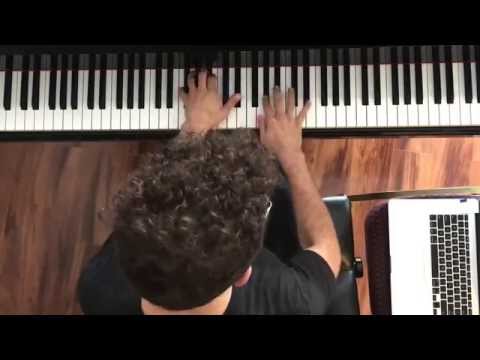
Playing outside the changes
- how far you can travel and still be understood, tracked by goal notes
At the piano
Tension is the fuel. The source course's functional definition works in every style: "a consonance is a sound that can rest; a dissonance is a sound that implies motion" (Source course, Lesson 5). Not a list of intervals, a test you apply by ear. Do the course's demonstration now. Play C major and let it sit. Add B♭ above the G, feel the tritone between E and B♭ pull, resolve to F. Then do it at the level of the key: establish C, establish G with a few chords, then play G7 and feel the same tritone pull back to C. First is tension inside a chord, second is tension between keys.
Harmonic rhythm. The pace of change is a compositional decision, and the source course calls it "one of the most powerful and least discussed tools in a composer's arsenal" (Source course, Lesson 11). Same tune, three amounts of urgency, nothing changed but the pace. Exercise 2 makes you do it.
The shape of a phrase. A phrase has a point of highest tension and it is almost never the last note. Write the shape before the notes: four bars, tension rising through bar 3, releasing in bar 4. Then find pitches that do that. Contour is the cheapest way to control it, and Greg said why: "You go up toward the goal and you go down toward the goal and the ear hears that. You understand it as music at that point. You're saying something."
Sections that arrive. The failure mode Greg names in student records is a section that exists because something got repeated. The alternative is a section that arrives because tension built to a level that had to break. Three tools do that work and you now have all three: goal notes walking in one direction over sixteen bars, harmonic rhythm accelerating into the arrival, and a dissonance level that rises and then drops the moment the new section starts.
Structural dissonance. The largest version of the same idea. In Mozart's K. 545 the exposition moves from C to G, and that move is the dissonance of the whole exposition. The recapitulation resolves it by putting the second theme in C instead of G (Source course, Lesson 5). Rosen's point, quoted in the course, is that "the dramatic content of a Classical sonata is not something the composer adds on top of the form. It is the form."
Miles does the same thing without the machinery. In "So What" he starts with almost entirely consonant note choices, adds chromatic material as the solo develops, peaks in the climactic chorus, and pulls back at the close (Source course, Lesson 5). One long arc of tension, built by note choice alone over a static harmony.
Exercises
1. Feeling modulation
Do. Play a ii-V-I in C, let C settle as home, then without pausing play a ii-V-I in F. Notice the moment C stops being home and becomes the dominant of F. Do it into four keys.
Done when: you can describe in one sentence, for each key, what happened to the pitch that used to be your tonic.
2. Harmonic rhythm, three speeds
Do. Record a twelve-bar blues in F three times: as written, with the harmony doubled in the first four bars, and with F7 held for eight bars before B♭7.
Done when: you can play all three from memory and name which one you would use to set up a new section, and why.
3. The descending bass, and the progressions
Do. Fix one melody note and write a progression whose bass descends by step for at least four chords while every chord still fits that note, using Greg's 1-5-3 and 1-5-9 shapes moved rather than rebuilt. Then learn I, minor v, IV, minor iv, I, II major, V in three keys, and the longer progression from the theory lesson: I, minor ii, minor iii, VI♯9♯5, ii, V, ♭VI, ♭VI sus, ♭VI7♭9.
Done when: four consecutive chords descend by step under one melody note, and you can play both progressions from memory in three keys with a chord-tone melody over each.
4. Mirror one cadence
Do. Map the seven notes of C major across the axis between E and E♭ and write the pairs. Mirror I to G7 to I, name the result, which is F minor with a natural 6, and play it.
Done when: you can produce any note's mirror in under two seconds and generate the mirrored cadence in three keys.
5. Phrase-shape drill
Do. On paper, draw the tension curve for four bars before writing any pitches. Then write three different four-bar phrases that follow that identical curve.
Done when: a listener hearing all three can point to the same bar as the peak in each.
6. Go out and come back
Do. Over a static C minor vamp, run the sequence C minor, A♭ sus, F♯ sus, A♭ minor-major, naming a goal note in each. Return to C minor.
Done when: you can state each goal note's function in its borrowed key, and the return sounds like a resolution rather than a rescue.
Compose
Write a two-section piece for piano, at least forty-eight bars, in which the second section arrives because the first built to it.
Constraints. The first section holds one constant element carried over from A13b, and its goal notes move in one direction across the section. Harmonic rhythm accelerates over the last eight bars before the change. The second section begins at a lower tension level than the bar before it, so the arrival reads as a release. Somewhere in the first section, hold one melody note while the harmony under it changes to a chord from a different scale, the ♭VI move from the theory lesson. Do not use a repeat to create the second section.
Notate in Sibelius. Above the score, write one sentence naming the long thought the piece moves through. If you cannot write that sentence, the piece does not have one yet.
Checkpoint
- You can define consonance and dissonance functionally and apply the test by ear to a chord you have never played.
- You can play a twelve-bar blues at three harmonic rhythms and say what each is for.
- You can write a progression with a stepwise descending bass under a fixed melody note.
- You can play the mirrored cadence in three keys and explain why the mirrored dominant leads upward.
- You can hear the arrival in G in the K. 545 exposition and the return to C in the recapitulation.
- You have the forty-eight-bar piece, its second section arriving without a repeat, and a one-sentence statement of its long thought.
Read
- Source course, Lesson 5 (Consonance, Dissonance, and Tension). Rosen's sentence, the functional definitions, the suspension in three stages, structural dissonance, and the dissonance continuum for improvisers. Do both keyboard experiments in the text. https://composition.gregspero.com/library/garnett-course.pdf
- Source course, Lesson 11 (Harmony as a Living System). Harmony as syntax rather than vocabulary, harmonic rhythm, and tonicization against modulation ("a tonicization is a tourist; a modulation takes up residence"). Read it before Exercise 2.
- Mozart, K. 545, first movement. Follow the tonal plan only: arrival in G in the exposition, wandering in the development, return to C with the second theme at home. You do not need to follow every chord.
- Charles Rosen, The Classical Style. Quoted throughout the source course. Read it in Part B. For now take the two quoted claims and test them against K. 545 by ear.